


4Runner Accessories: What to Add for Off-Road Trips
Toyota 4Runner accessories for off-road trips: four picks with 5th-generation (2010 to 2024) fitment as each maker states it, and an upgrade order by category.
Off road vehicle upgrades work best in a sensible order: reliability and protection before cosmetic changes. This hub covers protection, suspension concepts, skid plates, storage, air systems, and how to plan upgrades without overloading your vehicle.

As an Amazon Associate, Off Road Freedom earns from qualifying purchases. See our affiliate disclosure.
$1,099.95
View on Amazon (Rough Country 6" Lift Kit with N3 Shocks for Chevy Silverado & GMC Sierra 1500 4WD (1999-2006 & Classic) - Increased Clearance, Aggressive Look)$289.99
View on Amazon (TAC Running Boards Fit 2005-2023 Toyota Tacoma Double Cab Rocker Steps Pickup Truck Side Steps Nerf Bars Rock Slider Armor Off-Road Accessories Fine Texture Black (2pcs))$249.99
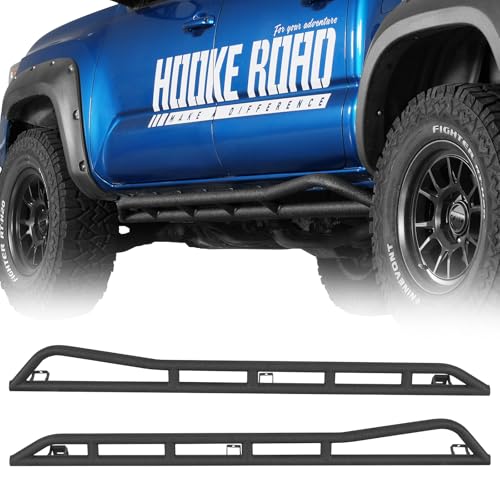
View on Amazon (Hooke Road Tacoma Rock Sliders Kick-Out Design for 2005-2023 Toyota Tacoma Double Cab (Exclude TRD Off-Road, TRD Sport), Steel Tube Rocker Guard Nerf Bars for Rock Crawling)$60.24
View on Amazon (ECOTRIC Black Nerf Bars Rock Sliders Compatible with 2014-2023 Polaris RZR | Fits 2014-2023 Polaris RZR XP 1000/Turbo/Turbo S, RZR 900/900 XC/S 900/S 1000(2 Doors) Left & Right Side Steps - 2 Seater)$228.99
View on Amazon (YZONA Rock Slider Compatible with 2020-2027 Jeep Gladiator JT 4 Doors | Running Boards | Heavy-Duty Carbon Steel Nerf Bars, Black Powder Coated)$219.99
View on Amazon (KEMIMOTO Rock Sliders Nerf Bar Compatible with Polaris General 1000 | XP 1000 2016-2027 2 Seat Side Step Bumper Protection Steel Frame UTV Accessories)Prices and availability were accurate when retrieved from Amazon and may change. Retrieved Nov 12, 2026.
The best upgrade list is shorter than most people expect. It starts with a question: what has gone wrong, or what is likely to go wrong, on the trails you actually drive? A vehicle that spends most of its time on gravel roads and mild trails needs different parts from one that crawls rocks every weekend. Buying for the second case when you live in the first just adds weight, cost and noise.
Each modification also changes the ones after it. Tires affect gearing and clearance. Suspension changes angles that affect driveline and steering. Armor and racks add weight that the springs and the roof must carry. Our beginner's guide, first off-road mods, covers the logic in one place, and lift kit vs leveling kit shows how the later steps depend on the earlier ones.
The table sets out an order that suits most builds. Cost bands are relative, not prices: low means a small spend, high means a major one. Effort is how much work it is to fit. Treat it as a default and move steps if your trails demand it.
| Step | Upgrade | Cost band | Effort | Main benefit |
|---|---|---|---|---|
| 1 | Tires that suit how you drive | Medium to high | Low (shop fit) | Grip and sidewall strength where you drive |
| 2 | Air: a compressor or inflator and a gauge | Low to medium | Low | Air down and back up safely |
| 3 | Skid plates and sliders | Medium | Medium | Protects the parts that are costly to fix |
| 4 | Rated recovery points and gear | Low to medium | Low | A safe place to pull from |
| 5 | Storage and a roof or bed rack | Medium | Medium | Gear secured and reachable |
| 6 | Lighting and power | Medium | Medium to high | See and run accessories safely |
| 7 | Suspension (lift or leveling) | High | High | Clearance and ride height |
| 8 | Regearing | High | High | Restores performance with bigger tires |
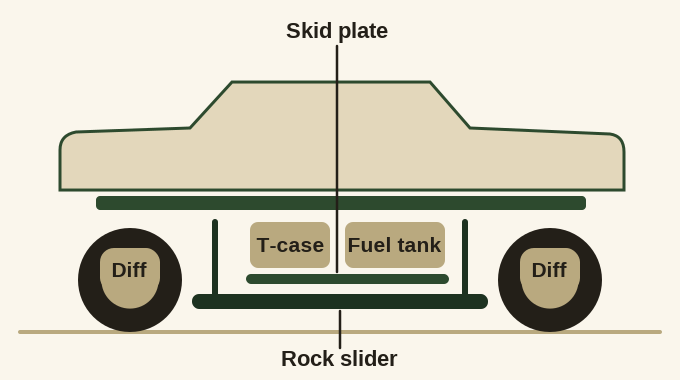
Armor protects the parts that cost the most to fix and cannot be driven without. Start by learning what is under your vehicle: the underbody armor map shows the differentials, transfer case and fuel tank, and what a skid plate is explains how the plates differ by material and coverage. Sliders guard the rocker area between the wheels, and rock sliders vs nerf bars explains why the two are not interchangeable.
Armor has trade-offs: weight, clearance under the plate, and the need to inspect fasteners after use. Check that a part lists your exact year, make and trim before ordering, and treat any maker's strength claim as the maker's claim, not a promise.
Air is the upgrade that pays back fastest. If you air down, you need to air up, and a compressor you trust makes both routine. Onboard vs portable air compares mount types, how to choose a compressor explains CFM and duty cycle, and our inflator picks list four by the maximum pressure each maker states.
Storage upgrades keep recovery gear and tools from becoming loose objects in the cabin. They also add weight, so check payload. The four vehicle pages below pick accessories by model: Bronco, Wrangler, Tacoma and 4Runner. For recovery points and rated gear, see the recovery gear hub.
Suspension work is the most expensive and the hardest to undo. A lift raises the vehicle, changes angles and often affects alignment, driveline vibration and brake lines. A leveling kit is a smaller change with its own limits. Fit them after the tires and protection you actually need, and plan the tire size at the same time, because the two have to agree.
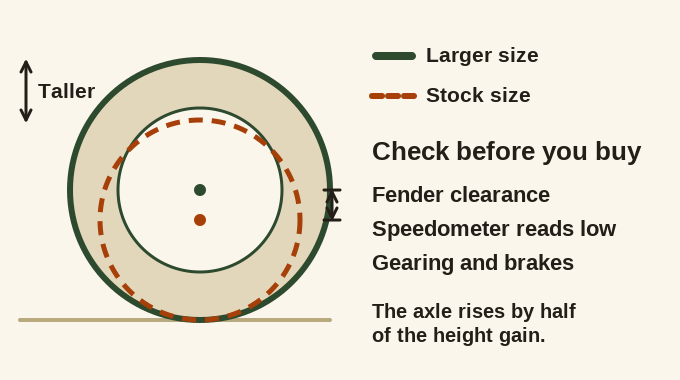
Check the size you want against the tools first. The tire size comparison shows the change in diameter, the speedometer error and the clearance gain, and the gear ratio calculator shows whether regearing is worth considering. Bigger tires lower the effective ratio, and the right answer depends on your vehicle and your driving.
Three rules save more money than any brand choice. First, confirm fitment on the maker's page for your model year and trim: where a listing is vague, we say "check fitment for your model year and trim" and mean it. Second, add up the weight. Roof racks, armor, drawers and a full tank of water add up quickly, and the owner's manual gives payload and the roof's dynamic load. Third, keep the vehicle legal and insured: lighting, bumpers and lift height are regulated in many places.
Where we list products on the vehicle pages and in the picks below, each fact comes from a maker page, a manual or the Amazon listing, and we say which. We chose them; we did not test them.
Every accessory has a weight, and the vehicle has limits. The owner's manual gives payload, which is the weight the vehicle can carry including passengers, and for many vehicles a separate roof load. Roof loads come in two kinds: a dynamic load, which is what the roof can carry while moving, and a static load, which applies when parked and is higher. A rooftop tent can be within the static figure and over the dynamic one, which is why the dynamic figure is the one that matters for the drive to the trail.
Add everything up before you buy: armor, drawers, a rack, a tent, water, fuel, recovery gear and passengers. Water alone is heavy, and fuel adds up. If the total is near the limit, drop items or choose lighter ones. We give no payload numbers of our own, because the figure belongs to your vehicle and trim, and the owner's manual is the source.
Where a maker states a capacity for its rack or drawer, such as the Smittybilt rack's stated on-road dynamic capacity or the DECKED payload, compare it with the vehicle's own limit and use the lower figure.
A short set of checks avoids most returns. First, fitment: confirm the model years, body style, trim and any options the listing names, and ask the maker if the page is vague. Second, the maker's claims: read what is stated as a fact, such as a material, a size or a rating, and treat marketing words as noise. Third, installation: check whether it bolts on, needs drilling or needs a professional, and whether it changes anything that affects safety, such as airbag sensors or brake lines.
Fourth, legality and insurance. Lighting, bumpers, lift height and tire size can be regulated, and a modification can affect cover, so ask. Fifth, the warranty: for a part that carries load, such as a rack or a recovery point, read the maker's terms and its instructions on use. Finally, check the return policy, because a part that does not fit is a part you want to send back.
If you are not sure a part is right, ask in a community of owners of the same vehicle, then verify what you hear on the maker's page. Opinions are useful for what to look for, and the maker's page is where the facts are.
Installing an upgrade is the start of owning it. Follow the maker's instructions, use the specified fasteners and torque, and ask a shop to do anything you are not equipped to do. After the first few trips, re-check bolts, mounts and welds, because vibration and rough ground loosen fasteners, and skid plates and sliders take hits that show up as dents and cracks.
Make inspection part of cleaning. Wash the underside, then look at plates, sliders, mounts and brackets, brake lines, boots and anything you added. A bent bracket or a cracked weld is easier to fix than a failure. Keep a note of when you installed each part and the torque or interval the maker states.
Armor and racks change how the vehicle behaves. A skid plate adds weight low down, a roof rack raises the centre of gravity and a lift changes angles. Drive it gently at first, listen for new noises and recheck alignment after suspension work. For what to look at after each run, see after the trail: a post-run inspection checklist, and for the longer view on maintenance, the maintenance and safety hub.
Five parts with fitment stated on the maker's page, chosen for roles that do not overlap. Check your exact year and trim on the maker's page before buying.
Cargo you can lock
Lockable drawers that keep recovery gear and tools from sliding.
DECKED product page, checked 2026-11-12
Roof rack for the Bronco 4-door
A full-length rack with removable bars, with its limits on the maker's page.
Smittybilt product page, checked 2026-11-12
Console security
A lockable box built into the console.
Tuffy product page, checked 2026-11-12
Tacoma bed rack
A tall bed rack for a rooftop tent or gear.
Leitner Designs product page, checked 2026-11-12
4Runner MOLLE
A steel panel for pouches and small tools in the rear window.
Victory 4x4 product page, checked 2026-11-12
Amazon buttons are affiliate links: we may earn from qualifying purchases. We chose these from maker pages; we have not tested them. See how we choose.
Check the numbers before you buy parts.
Every guide in this category, from checklists to how-tos and picks pages.
Toyota 4Runner accessories for off-road trips: four picks with 5th-generation (2010 to 2024) fitment as each maker states it, and an upgrade order by category.
First off road mods to consider: tires, recovery points, underbody protection, lighting and suspension, ordered by what helps most before a big build.
Ford Bronco accessories worth buying first: four picks with fitment as each maker states it, an upgrade order by category, and how to check your year and trim.
How to choose an off road air compressor: what CFM, duty cycle, amp draw and hose length mean, and how to match them to your tire size and power source.
Jeep Wrangler accessories for the trail: three picks with JK and JL fitment as each maker states it, an upgrade order, and how to check your generation and top.
Lift kit vs leveling kit: how each changes ride height, tire fit and handling, and what to plan for before you change your suspension.
Onboard vs portable air compressor: compare mounting, power draw, speed, cost and storage to decide which setup fits your rig and how you air up.
Rock sliders vs nerf bars: how sliders protect rockers and body seams on trails, how they mount to the frame, and when a nerf bar is enough.
Toyota Tacoma accessories for trail and camping: three picks with bed length and model-year fitment as the makers state it, and an upgrade order by category.
Underbody protection explained: a map of the differentials, transfer case, fuel tank and oil pan, and which armor covers each exposed component.
What is a skid plate? It shields the engine, transmission and other low parts from rocks. Learn what it covers, materials, and whether you need one.


Current Amazon results
Read what is included and check each item's stated rating.
See options on Amazon


Current Amazon results
Match the connector and flow to your tires; check the duty cycle before you rely on it.
See options on Amazon

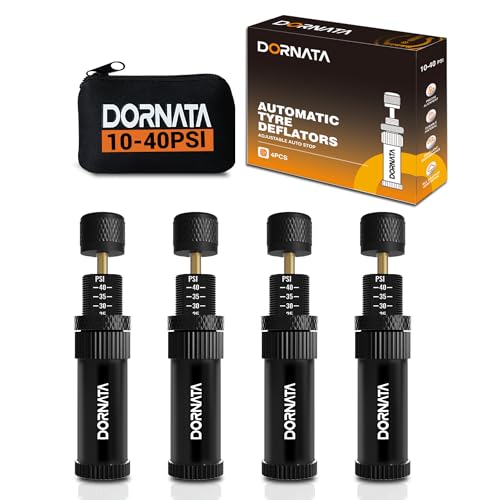

Current Amazon results
Match the connector and flow to your tires; check the duty cycle before you rely on it.
See options on Amazon
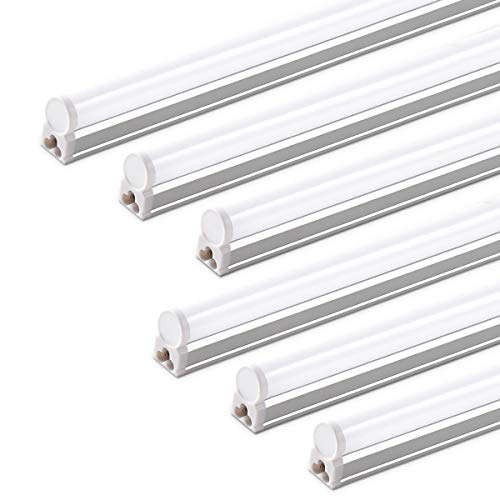

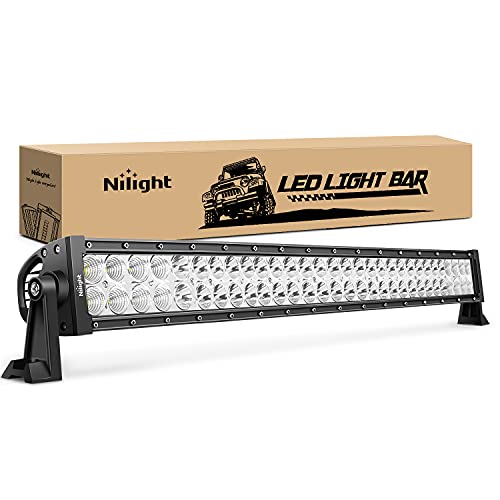
Current Amazon results
Check voltage, wiring needs and local rules on aux lighting before you buy.
See options on AmazonTires that suit how you drive, then a way to air them down and back up. They help on every trail and change nothing else about the vehicle's structure. Armor and recovery points follow.
It can affect coverage for related parts. Ask the manufacturer or dealer for the policy on your vehicle in writing before fitting one. We do not give warranty advice.
Check the dynamic roof load in your owner's manual, which is lower than the static load. Add the rack, the gear and a tent together and compare that to the maker's figure.
They protect different areas. Skid plates cover the underside, sliders protect the rocker area between the wheels. What you need depends on the trails you drive.
It is the maker's statement of which model years, trims and configurations the part is made for. A part that fits one trim may not fit another, so read the listing for your exact one.
Used armor and racks can be good value. Check welds, bends and fasteners, confirm the model years it fits, and be careful with anything that carries load, such as recovery points or racks.
Last checked 2026-11-12. Each link was opened and read on that date.
This guide reflects independent editorial research, not first-hand product testing, professional mechanical training, or rescue certification. Some links on this page are Amazon Associates affiliate links; see our affiliate disclosure.