






All-Terrain vs Mud-Terrain Tires: Which Do You Need?
All terrain vs mud terrain tires: how tread, noise, wear and traction differ, and how to match a tire to your terrain and daily driving.
Off road tires are one of the highest-impact choices for trail readiness. This hub covers tire types, sizing concepts, pressure basics, puncture and repair readiness, and general wheel considerations.

As an Amazon Associate, Off Road Freedom earns from qualifying purchases. See our affiliate disclosure.
$12.99$6.99
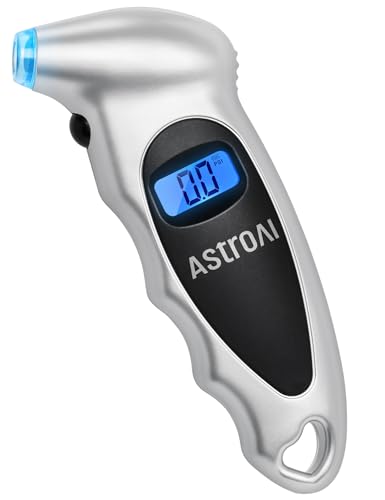
View on Amazon (AstroAI Digital Tire Pressure Gauge 150PSI, ±1PSI Accuracy for Car Truck | Industrial Tire Gauge Calibrated to ANSI B40.7 with 4 Settings for Motorcycle Bikes, Silver)$472.66
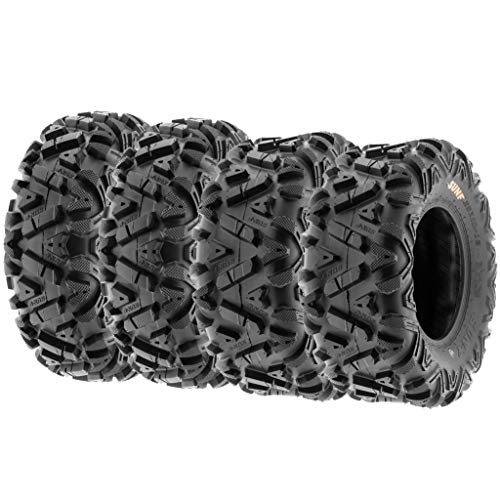
View on Amazon (GT Radial Adventuro AT3 265/70R16 111T All Terrain SL 16 inch Four Tires | Truck/SUV All Terrain All Season Traction 111T Rated Standard Load Radial Construction Outlined White Letters Tires)$13.29
View on Amazon (Zelythil Heavy Duty 4 Way Lug Wrench, Professional 14 Inch Cross Tire Iron Wrench, Universal Cross Wheel Lug Nut Removal Tool, Forged Heat-Treated Carbon Steel for Tire Changing and Auto Maintenance)$17.69
View on Amazon (CARTMAN 14 Inch Heavy Duty 4 Way Universal Cross Lug Wrench Tire Iron | Built with sturdy thick steel structure, 4 integrated sockets sized 17/19mm & 21/22mm for effortless vehicle tire maintenance)$138.07
View on Amazon (Prinx HiCountry A/T2 All Terrain 265/70R17 115T Light Truck Tire | Truck/SUV All Terrain All Weather Traction 115T Rated Standard Load Radial Construction Outlined White Letters Tire)$33.42$31.74
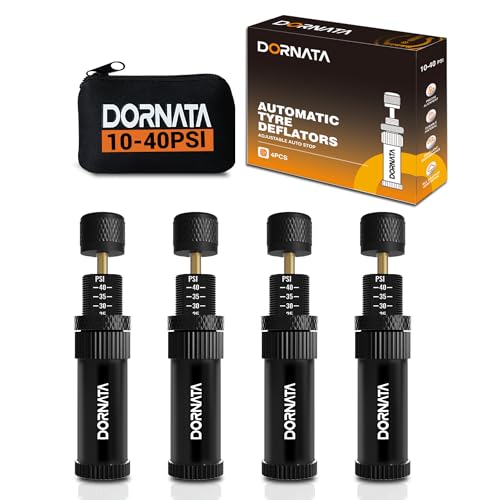
View on Amazon (DORNATA Adjustable Tire Deflator Auto-Stop (10-40 PSI) Offroad Accessories | Valve Stem kit 4x4 Tyre Air Down Tool for Truck, Pickup, Motorcycle,Jeep etc.(BLACK))$118.07
View on Amazon (Lexani Terrain Beast AT LT245/75R16 120/116S E | Light Truck All Terrain All Weather Traction 120/116S Rated E (10 Ply) Radial Construction Black Sidewall Tire)$39.90
View on Amazon (Rhino USA Adjustable Tire Deflator Kit (4-Pack) - 10-30 PSI Air Down Tool | Automatic Screw-On Deflators with Auto Stop. Offroad Accessory for Jeep, Truck, SUV, ATV & 4x4 Sand Trails. Black)Prices and availability were accurate when retrieved from Amazon and may change. Retrieved Nov 12, 2026.
Tires are the single largest lever you have over how a vehicle behaves off pavement. They decide how much grip you have, how well the sidewalls resist cuts, how the vehicle rides and how loud it is on the highway. They also decide how much of your drivetrain you are changing: a bigger tire raises the axle, shifts the speedometer and changes the effective gearing.
For that reason we put tires and wheels first in the list of upgrades. Before you buy, read how to read tire size so the numbers on the sidewall make sense, and use the tire size calculator to turn a size into diameter, width and sidewall height. Compare two sizes side by side with the tire size comparison tool, which also shows the speedometer error and the change in clearance.
Tires fall on a spectrum from road-biased to trail-biased. All-terrain tires aim for balance, mud-terrain tires trade road manners for grip in loose ground, and rugged-terrain tires sit between them. Which one you want depends on how much pavement you drive between trails, not on how serious your rig looks. Our comparison of all-terrain vs mud-terrain tires goes into the trade-offs in detail, and our all-terrain shortlist lists four by role with the figures each maker prints.
| Type | Built for | Trade-off | Choose it when |
|---|---|---|---|
| All-terrain (A/T) | A mix of pavement, gravel and easy trail | Less grip than mud-terrain in deep mud | Most of your miles are on road |
| Rugged-terrain (R/T) | More trail grip with road manners between mud-terrain and all-terrain | Noisier and wears differently than an all-terrain | You split time between road and rougher trail |
| Mud-terrain (M/T) | Loose, deep or slippery ground | More noise and a rougher highway ride | Mud and rock are the main event |
A tire is only half the setup. Wheel width and offset decide where the tire sits in the wheel well, and a wheel with the wrong offset can rub the suspension or push the tire outward past the fender. The wheel offset calculator converts offset to backspacing and compares two wheels. Use the tire size chart to look up diameters for the common sizes.
Taller tires also change the gearing. The gear ratio calculator shows engine RPM at a given speed and the equivalent ratio for regearing, and the speedometer calculator shows how far the dash will read from the truth. Results are nominal: the maker's spec sheet lists the actual diameter for a given tire.
If you are planning a bigger build, read planning a suspension upgrade alongside this hub, because tires, lift and gearing have to be chosen together.
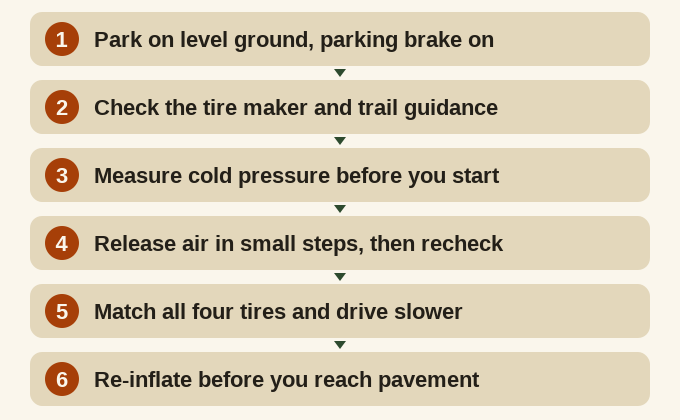
Lowering pressure on soft ground widens the footprint and improves grip. It also makes the tire easier to damage or unseat, so it is a trade-off, not a free upgrade. How to air down safely lays out the steps, and the tire pressure calculator works out the result from your own placard value rather than a number we invent.
You need a way to air back up, and that means a compressor or inflator you trust. Our inflator picks compare four by the maximum pressure each maker states.
Most trail flats are punctures in the tread. A plug kit and a way to inflate the tire get you moving, and a tire shop should inspect the tire afterwards. How to plug a tire on the trail gives the steps and the cases where a plug is the wrong answer, and our plug kit shortlist compares four kits by what the maker puts in the box.
A full-size spare is the dependable fallback when a sidewall fails, which a plug cannot fix. See planning for a full-size spare for fitment, mounting and rotation. Wheel fasteners need re-checking after a wheel change, and lug nut torque after off-roading explains why and where to find your value.
The seven tools on this site share one calculation engine, so the answers agree with each other. Use the table to pick the one that fits the question you have, and use the tools together when you are planning a bigger change: start with the size calculator, check the comparison, then check offset and gearing.
| Tool | Question it answers | Use it before |
|---|---|---|
| Tire size calculator | How big is this size in inches? | Buying any new size |
| Tire size comparison | How do two sizes differ? | Choosing between sizes |
| Tire size chart | What do common sizes measure? | Browsing sizes by rim |
| Wheel offset calculator | What offset or backspacing do I need? | Buying wheels |
| Gear ratio calculator | What RPM and ratio do I get? | Regearing or buying tires |
| Speedometer calculator | How far off is my speedometer? | Fitting a bigger tire |
| Tire pressure calculator | What does the pressure change do? | Airing down or checking in heat |
Most off-road tires spend most of their life on pavement, and a tire that excels in mud can be a poor daily driver. Be honest about the split. If you drive mostly road with some gravel and trail days, an all-terrain tire is usually the sensible compromise. If you drive more trail than road, a rugged-terrain tire might suit you. If mud and rock are the main event and the road is the commute to them, a mud-terrain tire earns its keep.
Also think about weather. A tire with the three-peak mountain snowflake marking has passed an industry snow-traction test, which can matter if you see snow. It is not a substitute for chains where they are required, and a dedicated winter tire may still do better in severe conditions. Our all-terrain shortlist states the marking each maker shows for its tire, and you should confirm it for your size.
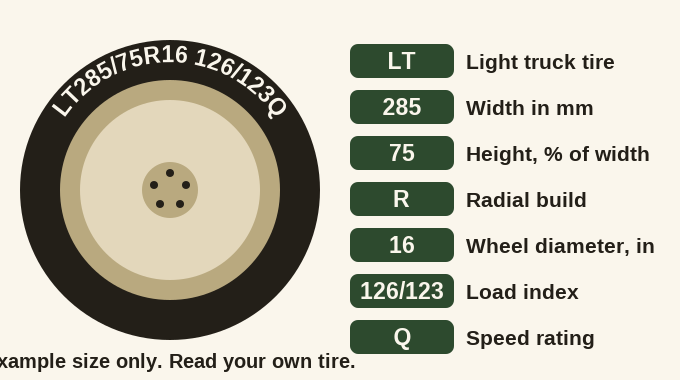
Tires are rated for load as well as size, and the rating is on the sidewall. A light truck (LT) tire is built for heavier loads and can carry more at a given pressure than a passenger-metric (P) tire of similar size, but it can also ride firmer. P-metric tires are built for passenger vehicles and light loads. Neither is better in every case: choose by the load your vehicle carries and the maker's guidance for your vehicle.
Load range and load index tell you how much a tire can carry, and the sidewall shows both. Our guide, how to read tire size, explains the codes in detail, and the diagram above shows where each code sits. If you carry heavy gear, a rooftop tent or a trailer, check the tire's load rating against the vehicle's needs and ask the tire maker or a shop if you are unsure.
Pressure and load go together. The placard on your vehicle gives the pressure for the original tire at the vehicle's rated load, and if you change tire type or size, the right pressure may change. Ask the tire maker or a shop, and do not guess. Our pressure calculator works from your own placard value rather than from a figure we invent.
Wheels are easy to overlook until one bends. Check rims for dents and cracks after rough trails, and clean the bead area before you re-seat or re-inflate a tire. If you run a wheel width or offset that is not stock, check clearance at full steering lock and at full suspension travel, since rubbing shows up on the trail, not in the driveway. The wheel offset calculator helps you compare a new wheel with your current one.
A full-size spare that matches your tires is the best fallback for sidewall damage, and a mismatched spare can affect the drivetrain and traction control. Planning for a full-size spare covers fitment, mounting and rotation. Rotate tires on the schedule in your owner's manual and the tire maker's warranty, because many mileage warranties ask for records.
Re-check wheel fasteners after any wheel change or hard use. The torque value comes from the owner's manual for your model year, and lug nut torque and re-torque after off-roading explains where to find it. Finally, keep a gauge in the vehicle: a gauge you trust is the best tire tool you can own.
Two tires, two ways to inflate and one plug kit, each chosen for a role of its own. The figures are the ones each maker prints, and we have not tested any of them.
Tire with a trial offer
A broad size range across 15 to 22 in wheels, with a trial offer.
Toyo product page, checked 2026-11-12
Tire with a long warranty
The highest treadwear figure on this list, with separate numbers for metric and LT sizes.
Nitto product page, checked 2026-11-12
Air from the 12V port
A plain corded compressor with a gauge and battery clamps, the kind that lives in a recovery bag.
Viair product page, checked 2026-11-12
Air from a battery or a wall
One inflator you can run from a battery, the vehicle's 12V port or a wall outlet.
DEWALT product page, checked 2026-11-12
Plug kit for the trail
A plug kit with a lot of repair material and a case that stays with the vehicle.
Safety Seal product page, checked 2026-11-12
Amazon buttons are affiliate links: we may earn from qualifying purchases. We chose these from maker pages; we have not tested them. See how we choose.
Use them together: size first, then comparison, offset and gearing.
Every guide in this category, from checklists to how-tos and picks pages.
All terrain vs mud terrain tires: how tread, noise, wear and traction differ, and how to match a tire to your terrain and daily driving.
Best all terrain tires for trucks and SUVs: four options by role, with the 3PMSF marking, treadwear warranty and sizes each maker states on its own page.
Best portable tire inflator picks for off-road use: four cordless and 12V inflators by role, with the max PSI, power source and shut-off the makers state.
A full size spare tire needs the right fitment, a secure mount and a rotation plan. Learn what to check before you carry one on the trail.
How to plug a tire on the trail: the tools, the steps, when not to plug, and why a plug is temporary and the tire needs a proper repair afterwards.
How to read tire size from the sidewall: width, aspect ratio, rim diameter, load index, speed rating and the other codes printed on every tire.
Tire pressure for off roading depends on terrain, load and tire. Learn how to air down in steps, what to watch for, and when to air back up for the road.
Best tire plug kit picks for trail repairs: four kits by role, what each maker puts in the box, and why a plug from outside is only a temporary fix.


Current Amazon results
Read what is included and check each item's stated rating.
See options on Amazon


Current Amazon results
Match the connector and flow to your tires; check the duty cycle before you rely on it.
See options on Amazon
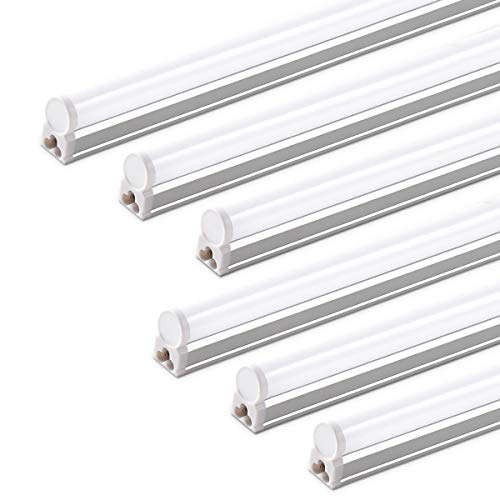

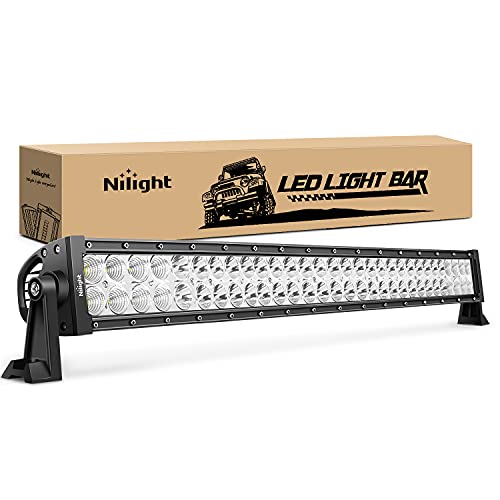
Current Amazon results
Check voltage, wiring needs and local rules on aux lighting before you buy.
See options on Amazon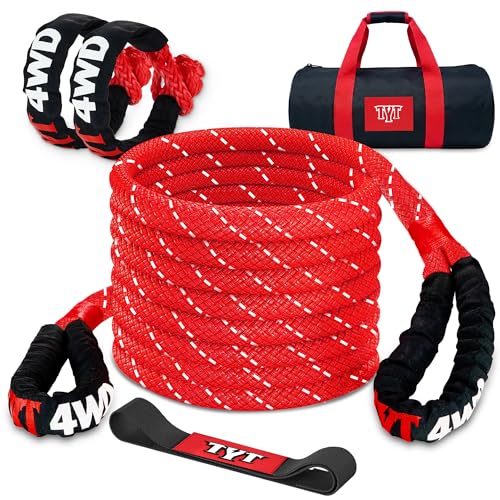


Current Amazon results
Check the maker's stated rating against your vehicle weight and never use a damaged one.
See options on AmazonIt depends on the vehicle, the wheel offset and the suspension, so no single answer is safe. Use the comparison tool for the change in diameter and width, then check clearance and the maker's guidance for your trim.
The three-peak mountain snowflake marking means the tire passed an industry snow-traction test. It is not the same as a dedicated winter tire, and each maker's all-terrain marked 3PMSF should be checked by size.
Not always. Larger tires lower effective gearing, which matters more with a heavy vehicle, a small engine or a tall step in diameter. The gear ratio calculator shows the effect so you can decide with numbers.
Check cold before you leave, after airing down, and again after re-inflating. A gauge you trust matters more than any rule of thumb, and the placard is the starting point.
A larger tire turns fewer revolutions per mile, so the speedometer under-reads your real speed. The speedometer calculator shows the actual speed for a given reading.
No. USTMA says no repair belongs in the shoulder or sidewall. Fit the spare and have a tire shop look at the tire.
Last checked 2026-11-12. Each link was opened and read on that date.
This guide reflects independent editorial research, not first-hand product testing, professional mechanical training, or rescue certification. Some links on this page are Amazon Associates affiliate links; see our affiliate disclosure.