
Tire Size Calculator: Diameter, Width and Sidewall
Worked example
Take a 35x12.50R17. A flotation size states its diameter first, so the tire is 35.0 in tall and 12.5 in wide. With a 17 in rim, each sidewall is (35 - 17) / 2 = 9.0 in. The circumference is 3.1416 x 35 = 110.0 in, so the tire turns about 576 times per mile.
35.0 in overall diameter
| Measure | Result |
|---|---|
| Size | 35x12.50R17 (flotation) |
| Overall diameter | 35.0 in (889 mm) |
| Section width | 12.5 in (318 mm) |
| Sidewall height | 9.0 in (229 mm) |
| Rim diameter | 17 in |
| Circumference | 110.0 in |
| Revolutions per mile | 576 |
Nominal sizes from the formulas. Real tires differ by maker and tread; the maker's spec sheet lists the actual diameter.
How to use this tool
- Enter the size
Type the size off your sidewall, or open "Enter width, aspect and rim instead" and fill in the three numbers. - Read the table
Overall diameter is the number to watch for fit and gearing. Sidewall height tells you how much rubber sits between the rim and the trail. - Compare a second size
To see what a swap changes, copy the result link and open the tire size comparison tool, or change the size here and compare the numbers.
Off-road gear on Amazon
SponsoredAs an Amazon Associate, Off Road Freedom earns from qualifying purchases. See our affiliate disclosure.
ETENWOLF Pencil Tire Pressure Gauge 2 Pack (10-50PSI, 20-120PSI) | Calibrated to ANSI B40.1 Grade B (2%), 16 Tire Caps, Stainless Steel Body, Stocking Stuffers for Men Women, Car Accessories
$7.99$5.99
View on Amazon (ETENWOLF Pencil Tire Pressure Gauge 2 Pack (10-50PSI, 20-120PSI) | Calibrated to ANSI B40.1 Grade B (2%), 16 Tire Caps, Stainless Steel Body, Stocking Stuffers for Men Women, Car Accessories)Rhino USA Adjustable Tire Deflator Kit (4-Pack) - 10-30 PSI Air Down Tool | Automatic Screw-On Deflators with Auto Stop. Offroad Accessory for Jeep, Truck, SUV, ATV & 4x4 Sand Trails. Black
$39.90
View on Amazon (Rhino USA Adjustable Tire Deflator Kit (4-Pack) - 10-30 PSI Air Down Tool | Automatic Screw-On Deflators with Auto Stop. Offroad Accessory for Jeep, Truck, SUV, ATV & 4x4 Sand Trails. Black)AstroAI Digital Tire Pressure Gauge 150PSI, ±1PSI Accuracy for Car Truck | Industrial Tire Gauge Calibrated to ANSI B40.7 with 4 Settings for Motorcycle Bikes, Silver
$12.99$6.99
View on Amazon (AstroAI Digital Tire Pressure Gauge 150PSI, ±1PSI Accuracy for Car Truck | Industrial Tire Gauge Calibrated to ANSI B40.7 with 4 Settings for Motorcycle Bikes, Silver)DORNATA Adjustable Tire Deflator Auto-Stop (10-40 PSI) Offroad Accessories | Valve Stem kit 4x4 Tyre Air Down Tool for Truck, Pickup, Motorcycle,Jeep etc.(BLACK)
$33.42$31.74
View on Amazon (DORNATA Adjustable Tire Deflator Auto-Stop (10-40 PSI) Offroad Accessories | Valve Stem kit 4x4 Tyre Air Down Tool for Truck, Pickup, Motorcycle,Jeep etc.(BLACK))Zelythil Heavy Duty 4 Way Lug Wrench, Professional 14 Inch Cross Tire Iron Wrench, Universal Cross Wheel Lug Nut Removal Tool, Forged Heat-Treated Carbon Steel for Tire Changing and Auto Maintenance
$13.29
View on Amazon (Zelythil Heavy Duty 4 Way Lug Wrench, Professional 14 Inch Cross Tire Iron Wrench, Universal Cross Wheel Lug Nut Removal Tool, Forged Heat-Treated Carbon Steel for Tire Changing and Auto Maintenance)Xuhal 20 Pack Tire Tread Depth Gauge Color Coded Measurement Bulk | Tyre Depth Gauge Tool 32nds Accurate Wear Indicator on Car Truck SUV Visual Safety Scale Easy Read Fleet Maintenance Tool
$17.99
View on Amazon (Xuhal 20 Pack Tire Tread Depth Gauge Color Coded Measurement Bulk | Tyre Depth Gauge Tool 32nds Accurate Wear Indicator on Car Truck SUV Visual Safety Scale Easy Read Fleet Maintenance Tool)CARTMAN 14 Inch Heavy Duty 4 Way Universal Cross Lug Wrench Tire Iron | Built with sturdy thick steel structure, 4 integrated sockets sized 17/19mm & 21/22mm for effortless vehicle tire maintenance
$17.69
View on Amazon (CARTMAN 14 Inch Heavy Duty 4 Way Universal Cross Lug Wrench Tire Iron | Built with sturdy thick steel structure, 4 integrated sockets sized 17/19mm & 21/22mm for effortless vehicle tire maintenance)





Prices and availability were accurate when retrieved from Amazon and may change. Retrieved Nov 12, 2026.
How it is calculated
- Sidewall (mm) = width x aspect / 100. Diameter (in) = rim + 2 x sidewall / 25.4. Section width (in) = width / 25.4.
- Diameter = first number. Width = second number. Sidewall (in) = (diameter - rim) / 2.
- Circumference = pi x diameter. Revolutions per mile = 63,360 / circumference.
Results are nominal. Real tires differ by maker and tread, and the maker's spec sheet lists the actual diameter.
Frequently asked questions
How do I turn a metric tire size like 285/70R17 into inches?
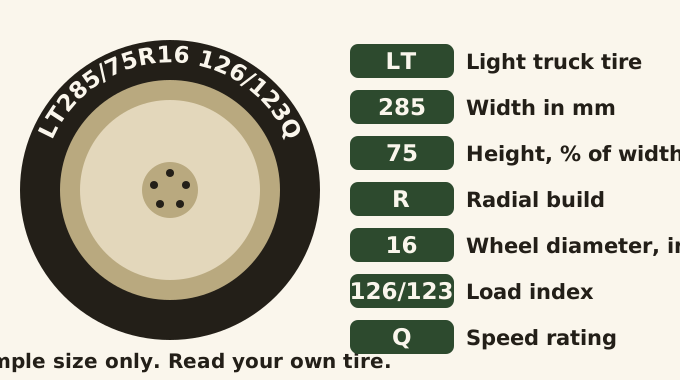
The first number is the width in millimeters, the second is the sidewall as a percent of that width, and the last is the rim diameter in inches. Sidewall = 285 x 0.70 = 199.5 mm, or 7.85 in. Add two sidewalls to the 17 in rim and the tire is about 32.7 in tall.
What does the 35 in 35x12.50R17 mean?
In a flotation size the first number is the overall diameter in inches, the second is the section width in inches, and the last is the rim diameter. So 35x12.50R17 is a tire about 35 in tall and 12.5 in wide that fits a 17 in wheel.
What is the difference between P and LT in front of a size?
P marks a passenger-metric tire and LT marks a light-truck tire. The size math is the same; the letters describe how the tire is built and rated, so check the tire maker's information before you swap one type for the other.
Is the calculated diameter the real diameter?
It is a nominal figure from the size code. Real tires vary by maker, tread design, wear and the rim width they are mounted on. The maker's spec sheet gives the actual diameter.
Why does the tool show revolutions per mile?
Revolutions per mile is 63,360 divided by the circumference in inches. It is the number gearing and speedometer math are built on, so it lets you compare sizes without guessing.
How much bigger can I go without changing anything else?
One tire maker's guidance is to keep overall diameter within about 3 percent of the original, and to expect speedometer and odometer error beyond that. Larger changes may also need gearing, clearance and recalibration work, which the other tools here cover.
Link to this tool
Your numbers are saved in the link, so anyone who opens it sees the same result.
Sources
Last checked 2026-11-12. Each link was opened and read on that date.
- BFGoodrich: How to read a tire sidewall: Size code: width in millimeters, aspect ratio, R for radial, rim diameter, P and LT prefixes.
- BFGoodrich: Changing tire size on a car: A different overall diameter changes speedometer and odometer accuracy.
This guide reflects independent editorial research, not first-hand product testing, professional mechanical training, or rescue certification. Some links on this page are Amazon Associates affiliate links; see our affiliate disclosure.