Overview
An off-road recovery kit should be planned around four factors: your vehicle's weight and recovery points, the terrain you typically encounter, your own training, and the manufacturer instructions for whatever equipment you carry. There's no single kit that fits every vehicle or every driver, which is why we focus this guide on how to think through the decision rather than a fixed shopping list.
Recovery equipment is only as good as the planning behind it. A kit assembled without understanding your vehicle's rated recovery points, or packed with items you've never practiced using, can create a false sense of preparedness. This guide covers the general categories worth understanding, along with the training and inspection habits that matter as much as the gear itself.
For a broader introduction to trip gear beyond recovery, see our off-road gear hub.
Match equipment to your vehicle
Before buying any recovery item, find your vehicle's actual loaded weight, not just its unloaded curb weight -- passengers, cargo, and aftermarket additions all add up. Recovery equipment rated capacity should be evaluated against that real-world weight, with a safety margin, rather than against the lightest possible version of your vehicle.
Next, identify your vehicle's factory or aftermarket-rated recovery points. Not every tow hook or frame attachment is designed for the forces involved in a vehicle recovery, and using the wrong attachment point is one of the more common sources of equipment failure. Your owner's manual is the right place to start; if it doesn't specify rated recovery points, that's worth resolving before you rely on any recovery technique involving your vehicle.
If you routinely travel with others, it's also worth understanding what recovery points their vehicles have, since a mismatched pairing between two vehicles can be just as important as your own equipment.
Core kit components
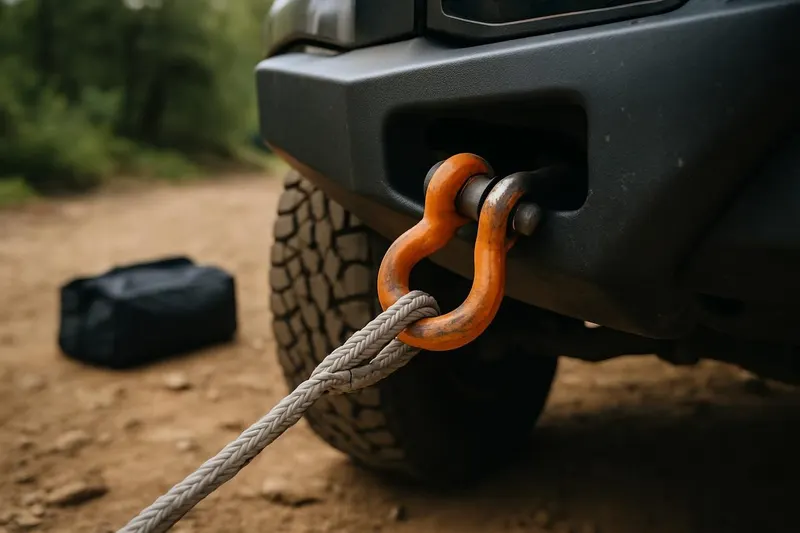
Most general-purpose recovery kits are built around a small set of categories: a tow strap or kinetic recovery rope, rated shackles or soft shackles to connect equipment to recovery points, a traction aid such as boards or mats for softer terrain, and gloves to protect your hands while handling gear under tension.
Beyond that core, some drivers add a winch and its accessories -- a winch line, a tree-protection strap, and a winch damper -- though a winch is a significant investment that makes the most sense for drivers who regularly travel remote or technical terrain. A simpler kit built around a strap, shackles, and traction aids covers a wider range of beginner and intermediate situations.
Our recovery gear hub covers these categories in more detail, and our dedicated guide on traction boards versus recovery straps explains when each tool is actually the right one for the situation.
Training and technique
Owning recovery gear and knowing how to use it safely are two different things. Before attempting an unfamiliar recovery technique, consider seeking hands-on instruction, whether through a local off-road club, a guided course, or an experienced and cautious mentor. Videos and articles, including this one, are useful for building general understanding, but they are not a substitute for supervised practice.
Solo recoveries carry additional risk simply because there's no second person to help assess the situation, communicate, or step in if something goes wrong. If you frequently travel alone, it's worth being more conservative about what terrain you attempt and keeping your recovery plan simple and well within your demonstrated skill level.
Whatever technique you use, keep bystanders clear of the load path, communicate clearly with anyone helping, and never stand near a line or strap under tension.
Inspecting and maintaining your gear
Recovery equipment degrades with use, sun exposure, and time, even if it looks fine at a glance. Before each trip, inspect straps and ropes for fraying, cuts, or UV damage; check shackles for cracks, deformation, or a pin that no longer threads smoothly; and confirm any winch line or cable is free of kinks or broken strands.
Store recovery gear away from prolonged sun and moisture when possible, since both accelerate wear on straps, ropes, and some hardware finishes. If any component shows visible damage, wear, or you're unsure of its condition or history, the safer choice is to replace it rather than risk using it.
Keep the manufacturer's instructions and rated capacity information for your specific equipment, either physically in your kit or saved somewhere accessible, so you can reference the actual specifications rather than relying on memory.
Browse our recommended gear
Our featured picks refresh periodically. While we update them, our editorial guides can help you find the right gear for your rig.
See our guidesCommon planning mistakes
A common mistake is buying recovery equipment based on what looks capable in a product photo rather than confirming it matches your vehicle's actual weight and recovery points. Another is assuming that owning a kit is the same as being prepared to use it -- equipment sitting untouched in a cargo area doesn't help without matching knowledge.
It's also easy to overlook regular inspection, especially for gear that doesn't get used often. A strap or shackle that sat in a hot trunk for a year deserves a careful check before its next use, not an assumption that it's still in the same condition as the day it was purchased.
Finally, avoid planning a recovery kit in isolation from the rest of your trip preparation. Recovery gear works best alongside good route planning, a shared travel plan, and realistic turnaround decisions -- see our trail skills hub for more on that side of trip planning.
Packing and carrying your kit
Store recovery gear where it's accessible without unpacking your entire cargo area, since you may need it after already-difficult driving conditions rather than at a convenient moment. A dedicated bag or bin keeps components together and makes it easy to notice if something is missing before a trip.
Consider weight and placement as well. Heavier recovery components, like winch accessories or multiple shackles, are best placed low and toward the vehicle's center to avoid negatively affecting handling or raising your center of gravity unnecessarily. See our off-road gear hub for general cargo organization ideas that apply beyond recovery gear specifically.
Traveling solo vs in a group
Recovery planning changes meaningfully depending on whether you typically travel solo or with other vehicles. A strap-based recovery isn't an option without a second capable vehicle, so solo travelers should weight their kit more toward self-recovery tools like traction boards and, for more remote or technical terrain, a winch.
If you travel in a group, agree on a general recovery plan before you need it -- who carries what equipment, how you'll communicate during a recovery, and which vehicle is best positioned to assist if needed. Sorting this out in advance is far more effective than improvising once a vehicle is already stuck.
Regardless of group size, err on the side of caution with route selection when traveling solo, since the margin for a recovery gone wrong is narrower without a second vehicle or extra hands available to help.
Final thoughts
A well-planned recovery kit starts with understanding your vehicle, not with a shopping list. Confirm your rated recovery points, choose equipment that matches your vehicle's real-world weight, seek training before attempting unfamiliar techniques, and inspect your gear regularly. Recovery equipment reduces some risk when used correctly, but it does not eliminate the inherent risks of off-road travel.
Revisit your kit periodically as your experience and typical trips change. A kit built for occasional local trail days may need meaningful additions before it's appropriate for more remote or technical terrain, and it's better to make that assessment ahead of time than to discover a gap while already relying on it.