
Are Off-Road Light Bars Street Legal? What to Check
Are light bars legal on the road? Rules vary by state, so learn what to check about covers, aim, color and wiring, and when to keep lights off-road only.
Off road lighting and power accessories can meaningfully improve trail safety when installed responsibly. This hub covers auxiliary lighting concepts, portable power, battery care, wiring safety, and communications gear.
As an Amazon Associate, Off Road Freedom earns from qualifying purchases. See our affiliate disclosure.
$9.99
View on Amazon (7 Inch Slim LED Light Bar, Truck Tractor Small LED Work Light Pods 12V-60V Off Road Fog Light 60W 6000lm, ATV UTV RZR Forklift Lawn Mower Golf Cart Dirt Bike MTB Baja eBike Headlight Mods)$149.99$127.49
View on Amazon (Auxbeam V-MAX Series 4'' Cube LED Light Pod 270° Side Shooter Ditch Lights | 72W 6960LM LED Pod with DRL, Spot Flood Combo Beam, Off-Road Lights with 270° Side shiooter, IP68 Waterproof)$11.99$10.78
View on Amazon (Nilight - NI -WA 06 LED Light Bar Wiring Harness Kit - 2 Leads 12V On Off Switch Power Relay Blade Fuse for Off Road Lights LED Work Light, 2 Years Warranty)$62.99
View on Amazon (Hovano 20 Pods White Rock Lights 6000K Pure White 36 LEDs SMD Chips | Super Bright Neon Underglow Light, IP68 Waterproof ,for Pickup Trucks SUV UTV ATV RZR Car Boats (White))$16.99
View on Amazon (Wiring Harness 1 Lead, Rfroad Lighting LED Light Bar Wiring Harness Kit for Fog Lights Off Road Driving Lights Work Light 12V 40A Relay Fuse On/Off Rocker Switch Nylon Wire Kit for Truck UTV ATV Boat)$52.99
View on Amazon (8 Pods Five Sided RGB Rock Lights for Trucks, Chasing Color App & Remote | Led Rock Lights for Jeep UTV SUV ATV Golf Cart, Music Mode, Waterproof Exterior Underglow Kits for Cars(Patented))$45.99$39.99
View on Amazon (NAOEVO 12 Inch LED Light Bar with 4PCS 4 Inch LED Pod/Off Road/Fog Lights | 540W 54000LM Spot Flood Combo Off Road Lights Bar, Aluminum LED Driving/Fog Light Bar for Truck Car ATV Boat, 1 Year Warranty)$49.99
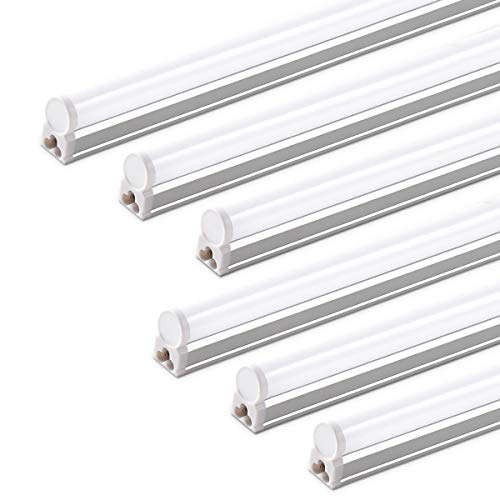
View on Amazon (Barrina T5 4FT LED Shop Lights for Garage, 2200lm, 6500K, 20W, 6 Packs | Super Bright White, Linkable Shop Light, Plug in Ceiling Workshop Garage Light, Cord with ON/Off Switch, ETL Listed)$49.99$44.98
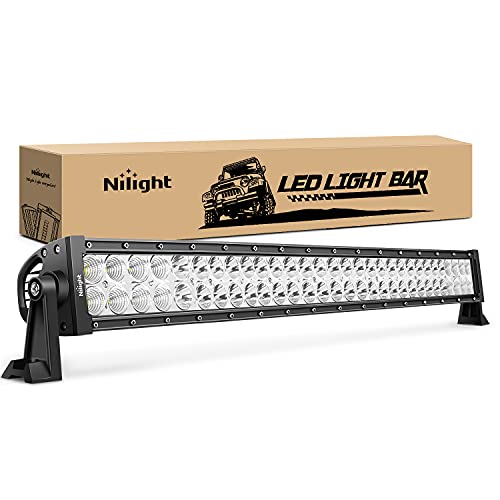
View on Amazon (Nilight LED Light Bar 32 Inch 180W 12600LM Spot Flood Combo Driving Lamp Roof Bumper Off Road Work Pods for Van Camper Wagon Car Pickup Golf Cart ATV UTV SUV Truck Boat 4x4)$44.99
View on Amazon (Nicoko 4Pods Pure White 72 LEDs SMD Chips 72w High Power Rock Lights Super Bright White Offroad Car Boat Underglow Lights IP68 Waterproof for Truck SUV UTV ATV RZR)Prices and availability were accurate when retrieved from Amazon and may change. Retrieved Nov 12, 2026.
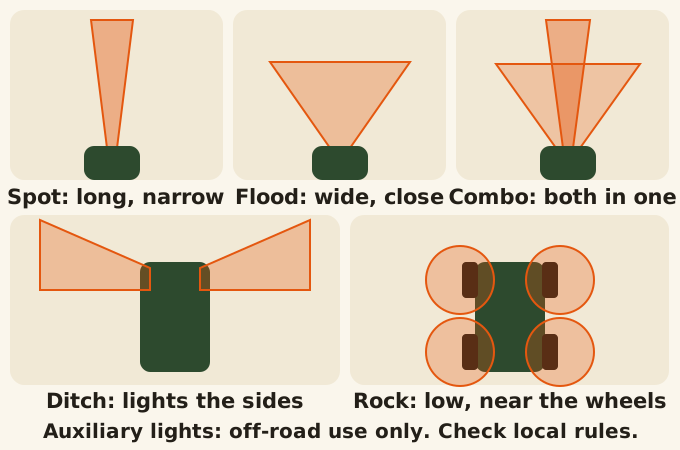
Lumens are the number on the box, but they say little about how a light works. A spot beam throws a narrow, long pattern for distance. A flood beam spreads wide and close, for camp or slow technical trails. A combo bar mixes the two, and ditch and rock lights each fill a particular gap. The right choice depends on where you drive and at what speed.
The diagram shows how the patterns differ. Our spot vs flood vs combo guide explains the trade-offs, and the lighting guide for beginners covers light bars, ditch lights and rock lights in one place. Remember that a stated lumen figure is the maker's claim, measured by the maker's method, so two makers' numbers are not directly comparable.
The table compares the common types by beam, where they mount, what they are used for and what to check on legality. It is a guide to what to check, not a statement of what is legal anywhere.
| Light type | Beam | Typical mount | Typical use | Legal note |
|---|---|---|---|---|
| Light bar | Spot, flood or combo | Roof, bumper or grille | Forward lighting on the trail | Check your state's rules and covers on public roads |
| Ditch lights | Wide spot to the side | A-pillar or hood hinge | Seeing the edges of the trail | Check number allowed and when on |
| Pods and driving lights | Spot or flood | Bumper or grille | Forward fill, close work | Check state rules for auxiliary lights |
| Rock lights | Wide, low | Under the body | Lighting the ground around the tires | Often limited to off-road use; check your state |
| Camp and work lights | Flood | Roof rack or portable | Lighting a camp | Use off the road |
Auxiliary lights are regulated, and the rules differ by state. Things to check include the number of auxiliary lights allowed, whether they must be covered on public roads, mounting height, colour and whether they may be on together with the headlights. We link a state's vehicle code only where we opened and confirmed the page, and we make no "street legal" claim for any product. Our guide, are off-road light bars street legal, lists what to check.
Be considerate on the trail as well. A bright light bar can dazzle a driver in front or coming the other way, and covers or switching them off for other traffic is common courtesy.
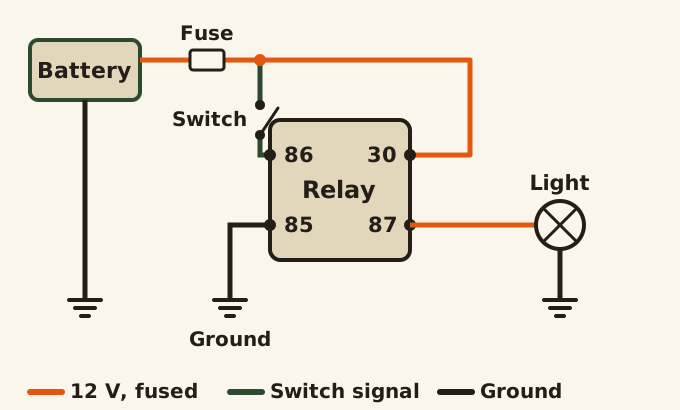
Lights draw current, and current needs a proper path. The basic pattern is a fused feed from the battery to a relay, a small control wire from a switch to the relay, and a ground. The relay carries the load, and the switch only carries a small signal. Our light bar wiring diagram walks through the pattern step by step, and the diagram below shows it.
Follow the light maker's diagram for fuse and wire sizes, fit the fuse close to the battery, use a relay for high-current loads, and disconnect the negative terminal before work. If you are not sure, ask a qualified installer.
Good connections matter as much as the diagram. Use crimp terminals sized for the wire, seal joints with heat-shrink, protect runs with split loom and keep wires away from heat, sharp edges and moving parts. Leave a drip loop where a wire enters a connector so water runs away from it, and tie wires down so they cannot rub through. Test every circuit with the light on for a few minutes and feel for warm connectors, because a warm connector is a bad connection that is turning current into heat.
Lights are only one 12V load. A fridge, a compressor, a radio and chargers all draw from the same battery, and the starting battery needs to keep enough charge to start the engine. A second battery or a charger that isolates the accessories fixes that. Dual battery setup, explained shows the layouts, and battery care: testing, charging and mounts covers keeping the battery healthy.
For camp power away from the vehicle, a portable power station is an alternative. How to size a power station gives the arithmetic, and our power station shortlist lists four by role with the figures the makers print.
Energy is power times time: watts times hours gives watt-hours (Wh). The table adds up a sample day with example draws. They are examples only: read the label on your own gear. Divide the total by the usable capacity of your battery or power station to see how long it lasts, and remember that the usable fraction is less than the label capacity, so we treat any runtime as an estimate.
| Load | Example draw (assumption) | Hours | Energy (Wh) |
|---|---|---|---|
| Light bar | 60 W | 2 | 120 |
| Camp lights | 10 W | 4 | 40 |
| Phone and radio charging | 15 W | 2 | 30 |
| Compressor fridge, average | 40 W | 24 | 960 |
| Total for the day | 1,150 |
Where a light sits decides what it does. A roof-mounted bar sits high and throws light over the hood, which reduces glare off the hood and gives a longer view. A bumper bar sits low, which lights the ground in front and can cast shadows from bumps. Ditch lights near the A-pillar light the edges of the trail, and rock lights light the ground around the wheels for slow technical work. The mounting map in our lighting guide shows the common positions.
Aim matters as much as position. A light aimed too high dazzles oncoming traffic and washes out your own view, and a light aimed too low wastes its reach. Aim on level ground against a wall at a distance the light maker suggests, and use covers on public roads where your state requires them. Mount lights on solid points, use the maker's brackets and re-check the bolts after rough use.
A vehicle's electrical system has limits, and accessories can exceed them. Add up what you plan to run: lights, a compressor, a fridge, a radio, chargers and a winch. A winch and a compressor are the biggest loads, drawing a lot of current for short periods, while a fridge draws less and runs for days. Each load needs a wire sized for it and a fuse that protects the wire, with values from the maker's instructions, not from a general chart.
Think about where the power comes from. The alternator charges the battery while the engine runs, but when it is off the battery has to carry everything. A second battery with a charger or isolator separates accessories from the starting battery, as explained in dual battery setup. A portable power station is a separate source that you can carry, which suits camp loads. Our power station shortlist gives four options by role, and the maker's figure for each is beside it.
Finally, protect the circuit. Fuse close to the battery, use a relay for high-current loads and keep connections clean and tight. A loose or corroded connection heats up, and heat is how electrical fires start.
Most electrical problems on the trail are connections. If a light flickers or a fridge cuts out, check the ground first, then the fuse and relay, then the connectors for corrosion or looseness. Keep a multimeter, spare fuses of the types you use and a few connectors in the tool kit; our trail tool kit guide lists the basics.
Care is mostly inspection. Look at wiring for chafing where it passes through the body, check the battery terminals for corrosion, and test the battery before a long trip. Off-road battery care covers testing, charging and mounts. Keep lenses clean, and check seals if a light has fogged, since moisture inside a light is a sign of a failed seal.
Finally, follow the rules. Check your state's requirements for auxiliary lights before you use them on a public road, keep covers on where required and avoid dazzling other drivers on the trail. For legal checks, see are off-road light bars street legal, which lists what to check rather than making claims for any state.
A light bar, a fridge and two power stations, each chosen for a different role in a 12V setup. The figures are those the makers print; the bar ships without a harness, as its page says.
Stated lumens and warranty
A compact bar with a lumen figure and warranty stated on the maker's page.
Baja Designs product page, checked 2026-11-12
A 12V load worth planning for
A compressor fridge with a battery-protection system the maker describes.
Dometic product page, checked 2026-11-12
12V outlet and fast USB-C
A mid-size LiFePO4 station with two fast USB-C ports and a 12V outlet for a fridge.
EcoFlow product page, checked 2026-11-12
Highest output
The highest continuous output of the three, with a long cycle rating.
Anker SOLIX product page, checked 2026-11-12
Amazon buttons are affiliate links: we may earn from qualifying purchases. We chose these from maker pages; we have not tested them. See how we choose.
Power and wiring depend on your vehicle: use the tools and guides together.
Every guide in this category, from checklists to how-tos and picks pages.
Are light bars legal on the road? Rules vary by state, so learn what to check about covers, aim, color and wiring, and when to keep lights off-road only.
A dual battery setup adds a second battery for a fridge, lights and gear. See how isolators and DC-DC chargers differ, how the layout works and fusing.
A light bar wiring diagram with a relay, fuse and switch: what each wire does, relay terminals 30, 85, 86 and 87, and how to wire it step by step.
Off road battery maintenance basics: how to test a battery, charge it correctly, check terminals, and secure it so vibration does not cut its life short.
An off road lighting guide to light bars, ditch lights and rock lights: what each does, how beam patterns differ, and how to plan power and wiring.
Portable power station sizing explained: add up your device watts and run time, compare watt-hour capacity, and choose between battery chemistries.
Spot vs flood light bar beams: how each pattern lights the trail, why combo bars exist, and how to choose a beam for speed, distance or close work.


Current Amazon results
Read what is included and check each item's stated rating.
See options on Amazon


Current Amazon results
Match the connector and flow to your tires; check the duty cycle before you rely on it.
See options on Amazon


Current Amazon results
Match the connector and flow to your tires; check the duty cycle before you rely on it.
See options on Amazon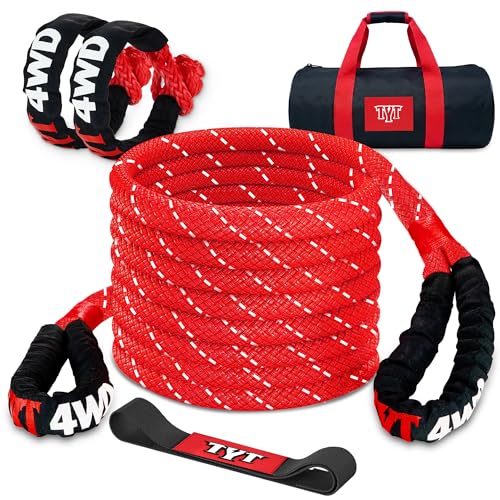


Current Amazon results
Check the maker's stated rating against your vehicle weight and never use a damaged one.
See options on AmazonThere is no single answer. Lumens are the maker's measure, and beam pattern, mounting position and speed matter more. Choose the pattern first, then compare lights of similar type from makers who state how they measure.
Follow the light maker's wiring diagram. Most high-current lights are wired through a relay so the switch only carries a small signal, with a fuse close to the battery.
It depends on your state. Check the number allowed, covers, mounting height and colour with your state's vehicle code. We make no street-legal claims.
It is the maker's statement of dust and water protection. A higher second number means more water protection. It does not tell you about brightness or legality.
Accessories draw current while the engine is off. A second battery with a charger, or a separate power station, keeps the starting battery for starting.
Divide the usable energy by the load in watts. The usable energy is less than the label capacity, so treat the result as an estimate and leave a margin.
Last checked 2026-11-12. Each link was opened and read on that date.
This guide reflects independent editorial research, not first-hand product testing, professional mechanical training, or rescue certification. Some links on this page are Amazon Associates affiliate links; see our affiliate disclosure.