Overview
A vehicle-based off-road camping checklist generally covers five areas: shelter and sleeping, water and food, power and lighting, waste and cleanup, and weather adaptability. Vehicle-based camping has an advantage over backpacking in that weight matters less, but that can also lead to overpacking -- a simple, organized setup usually works better than trying to bring everything possible.
This guide covers what each category typically includes for a beginner setup. See our off-road camping hub for more detail on any individual topic, and our off-road gear hub for general trip essentials beyond camping specifically.
As with a general trip checklist, it helps to build your camping kit gradually rather than buying everything at once. Start with the basics that make a single overnight comfortable, then add refinements -- better power management, a more capable kitchen setup, or additional shelter options -- as you learn what your actual trips require.
Shelter and sleeping
Shelter options for vehicle-based camping range from a simple ground tent to a rooftop tent mounted to the vehicle, to sleeping inside the vehicle itself with a platform or mattress setup. Each has trade-offs: rooftop tents set up quickly and keep you off the ground but add weight and height to your vehicle; ground tents are typically less expensive and more flexible about campsite placement; in-vehicle sleeping needs the least setup but requires enough interior space.
Whichever shelter you choose, match your sleeping system -- sleeping bag rating, pad insulation, and pillow -- to the actual temperatures you expect, not just the average seasonal temperature. Nighttime temperatures at elevation or in exposed areas can drop well below what you'd expect from the daytime forecast.
Consider setup and teardown time as part of your decision too, particularly if you plan to move camp frequently or arrive after dark. A shelter that takes twenty minutes to set up correctly is a different experience after a long drive than one that unfolds in under a minute.
Water and food
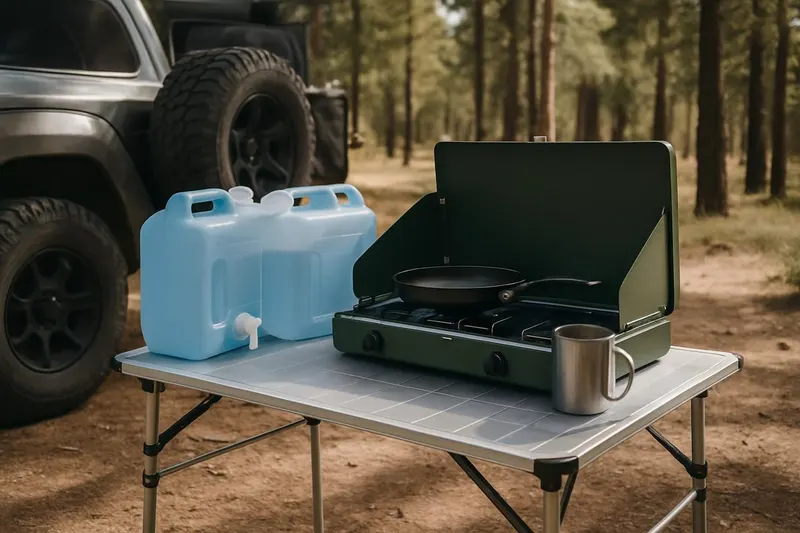
Plan water for drinking, cooking, and basic cleanup, with a reasonable safety margin beyond your estimated need. Water storage options range from simple jugs to dedicated tanks with a pump or gravity-fed spigot, depending on trip length and group size.
For food, a portable stove, basic cookware, and a cooler or portable refrigerator cover most vehicle-camping needs. Portable refrigerators offer more consistent temperature control than a traditional cooler but require reliable power, which ties directly into your power setup described below. Store food securely and be aware of local wildlife guidance for your camping area -- some regions require specific food-storage practices.
Browse our recommended gear
Our featured picks refresh periodically. While we update them, our editorial guides can help you find the right gear for your rig.
See our guidesPower and lighting
Camp power needs vary widely based on what you're running -- charging phones and running camp lights is a modest load, while a portable refrigerator or larger electronics draw considerably more. A portable power station, a dedicated auxiliary battery, or your vehicle's own electrical system (used carefully, to avoid draining your starting battery) are the common options.
For lighting, a mix of a hands-free headlamp, a lantern for ambient camp light, and your vehicle's own lighting for setup and teardown covers most situations. See our lighting and electrical hub for more on camp lighting and portable power options.
Waste and cleanup
Pack out everything you pack in, including food waste and trash -- most dispersed camping areas have no collection service, and improperly disposed of waste affects both the environment and future visitors. A simple system of separate bags for trash and recyclables makes packing out easier than a single mixed bag.
For human waste in areas without facilities, follow Leave No Trace guidance for your specific location, which may include a portable toilet system or specific burial depth and distance-from-water requirements depending on local regulations. Check requirements for your specific camping area in advance, since they vary by land management agency and region.
Camp kitchen organization
A camp kitchen works best when it's organized as a self-contained unit -- stove, fuel, basic cookware, utensils, and cleanup supplies stored together rather than scattered across the vehicle. A dedicated bin or drawer for kitchen gear means you're not hunting through camping equipment and recovery gear alike just to find a spatula.
Keep cooking fuel stored securely and away from heat sources while driving, and check your specific fuel type's storage recommendations, since propane, butane, and liquid fuel canisters each have different handling considerations. A simple cleanup kit -- biodegradable soap, a scrub brush, and a way to strain and pack out greywater -- keeps a camp kitchen from becoming a mess by the end of a trip.
For longer trips, plan meals that minimize perishable ingredients if you're relying on a cooler rather than a powered refrigerator, since ice supply and cooler performance both degrade over several days in warm weather.
Site selection and setup
Choose a campsite on durable, already-impacted ground where possible, rather than driving onto vegetation or soft soil to create a new site. Established dispersed campsites are usually visible from prior use -- flat, cleared ground without vegetation -- and using them instead of creating new ones reduces overall impact.
Check for site-specific hazards before settling in: dead overhead branches that could fall, low areas that could flood in rain, and proximity to water sources, since many land-management agencies require camping a minimum distance from streams and lakes. Confirm any campfire plans align with current fire restrictions for your specific area, which can change seasonally with little notice during dry conditions.
Browse our recommended gear
Our featured picks refresh periodically. While we update them, our editorial guides can help you find the right gear for your rig.
See our guidesPacking for changing weather
Weather can shift quickly, especially at elevation or in exposed terrain, so pack layers and a way to stay dry even if the forecast looks favorable when you leave. A simple tarp or awning extends usable outdoor space during rain and adds shade during heat, making it one of the more versatile additions to a camp kit.
Check weather and any fire restrictions for your specific camping area before you go, since conditions and rules can change seasonally and sometimes with little notice during dry periods.
Wind is often underestimated compared to rain or cold. Stake out tents and awnings properly even if the forecast looks calm, and have a backup plan for securing loose items if wind picks up overnight while you're asleep.
Adjusting for trip length and group size
A single-night trip with one or two people needs a much smaller kit than a multi-day trip with a larger group. Water, food, fuel, and waste-management needs all scale with both trip length and headcount, so it's worth doing rough math -- water per person per day, fuel per meal, trash volume per day -- rather than guessing at quantities.
Longer trips also benefit from redundancy in a few key areas: a backup water-purification method in case your primary supply runs low, spare batteries or a way to recharge power banks, and a slightly larger first-aid kit than you'd carry for a single overnight. Build your checklist around your specific trip's length and group size rather than a single fixed list used for every outing.
Final thoughts
A functional vehicle-camping setup doesn't need to be elaborate: reliable shelter and sleeping gear matched to expected temperatures, enough water and simple food options, a power plan sized to your actual electronics, a waste plan that leaves no trace, and layers for changing weather. Build gradually based on the trips you actually take, and revisit your kit each season as your habits and destinations change.
See our trail skills hub for route-planning and Leave No Trace concepts that pair naturally with vehicle-based camping, and our off-road gear hub for general trip essentials to combine with a camping-specific kit.