Overview
Choosing an off-road air compressor mostly comes down to four factors: duty cycle, airflow relative to your tire size, power source, and whether you want a portable unit or a permanently mounted onboard system. This guide explains each concept in plain terms so you can compare options against your own vehicle and driving style, without relying on invented performance numbers.
Air compressors matter on the trail because adjusting tire pressure for terrain -- lower for soft sand or rocky sections, higher again for paved roads -- is one of the more useful and low-risk habits for both traction and tire protection. A compressor is what makes airing back up practical once you leave the trail. See our tires and wheels hub for more on pressure adjustment itself.
Duty cycle, explained
Duty cycle describes how long a compressor can run continuously before it needs to rest and cool down, usually expressed as a run time followed by a required rest period. A compressor with a short duty cycle might be fine for topping off pressure but struggle to air up several larger tires from a low starting pressure without pausing partway through.
If you regularly air down significantly for trail sections and need to air back up multiple tires afterward, a longer duty cycle becomes more valuable. If you mostly make small pressure adjustments, a shorter duty cycle unit may be perfectly adequate. Check the manufacturer's documented duty cycle rather than assuming a compressor can run indefinitely, since overheating can shorten a compressor's working life or cause it to stop mid-task.
Airflow and tire size
Airflow, often listed in liters or cubic feet per minute, determines how quickly a compressor can fill a given tire volume. Larger tires simply hold more air, so the same compressor will take longer to air up a larger tire than a smaller one. If your vehicle runs larger tires, or you plan to upgrade tire size later, it's worth choosing a compressor with some margin rather than one sized to bare minimum for your current tires.
Manufacturers typically publish airflow specifications for their products -- compare those figures directly rather than relying on marketing language alone, and remember that real-world fill times also depend on starting pressure, target pressure, and ambient temperature.
Power source options
Most portable off-road compressors run from a vehicle's 12-volt outlet or direct battery clamps, while some higher-output units require a more robust electrical connection. Confirm your vehicle's electrical system and any relevant fuse ratings can support the compressor you're considering, especially for higher-draw units.
A small number of compressors are designed to run from a portable power station or built-in air system instead of directly from the vehicle. These can be convenient for camp use beyond just tires, but they add cost and complexity compared to a simple 12-volt unit. Match the power source to how you'll actually use the compressor most often.
Portable vs onboard systems
Portable compressors are self-contained units you store in the vehicle and connect only when needed. They're generally less expensive, easier to move between vehicles, and simpler to install, since there's no permanent mounting or wiring involved.
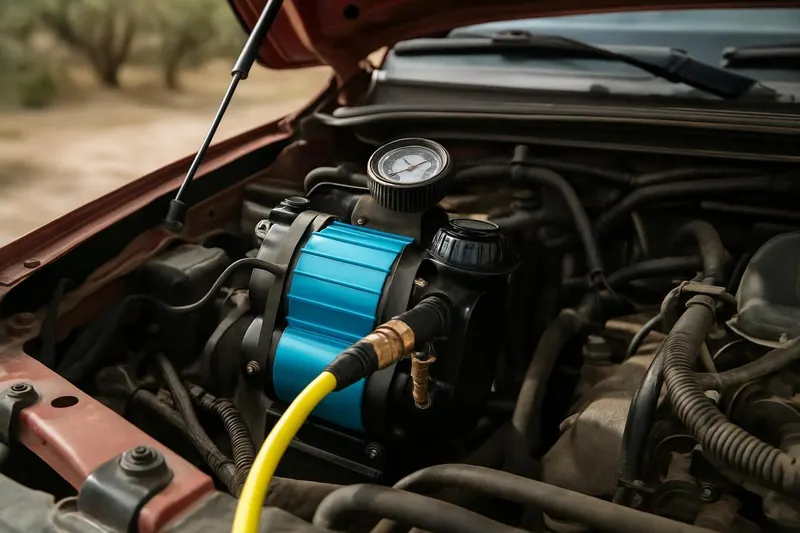
Onboard systems are mounted permanently, often under the hood, and wired into the vehicle's electrical system. They tend to offer more consistent performance and faster fill times, at the cost of a more involved and typically professional installation, and they aren't easily moved to a different vehicle later.
For most beginners, a portable compressor is a reasonable starting point. An onboard system becomes more attractive for drivers who air down frequently, run larger tires, or want a compressor that's always ready without extra setup.
Browse our recommended gear
Our featured picks refresh periodically. While we update them, our editorial guides can help you find the right gear for your rig.
See our guidesUsing a compressor safely
Whatever compressor you choose, a few habits reduce the chance of a problem. Let the compressor rest according to its documented duty cycle rather than pushing it to run continuously beyond that limit, since overheating can damage the motor or trigger a thermal shutoff mid-task. Keep the compressor's intake clear of dust and debris where possible, since airborne dirt can accelerate wear on internal components.
Check tire valve stems and caps for damage before connecting the compressor, and reinstall valve caps afterward to keep debris out of the valve mechanism. If you're airing up after a trail section, brush or wipe visible mud and debris away from the valve area first, since it can otherwise work its way into the valve during inflation.
Finally, recheck pressure with a separate, reliable gauge after airing up, especially if your compressor's built-in gauge isn't precise. A quick cross-check helps confirm you've reached your intended pressure rather than relying on a single reading.
Other features to consider
Beyond duty cycle, airflow, and power source, consider a few practical details: hose length (longer hoses reach all four tires without repositioning the compressor), an integrated pressure gauge for convenience, a carrying case to keep the unit protected in storage, and noise level if that matters to you during use at a campsite.
Also consider how the compressor will be stored and secured while driving. A loose compressor bouncing around a cargo area during rough terrain is both a nuisance and a minor safety concern -- see our off-road gear hub for general cargo organization ideas.
If you plan to use the compressor for anything beyond tires -- inflating a camp mattress or a small recreational item, for example -- confirm it includes the right adapter fittings or that you're prepared to carry a separate adapter kit, since not every compressor ships with a full set of attachments.
Budget vs capability trade-offs
Lower-cost compressors typically trade off duty cycle, airflow, and build durability compared to higher-cost units, which isn't necessarily a problem if your needs are modest. A driver who occasionally tops off pressure for daily driving has very different requirements than one who airs down significantly for every trail outing and needs to air four larger tires back up quickly afterward.
Rather than defaulting to the most expensive option available, match the compressor's specifications to your actual use case: your tire size, how often you air down, and how much time you're willing to spend waiting for tires to fill. Buying more capability than you need isn't wrong, but it's not necessary either, and that budget might be better spent elsewhere in your gear kit.
If your needs grow over time -- larger tires, more frequent trips, or a switch to a vehicle with bigger wheels -- it's reasonable to upgrade your compressor later rather than over-buying up front for a use case you don't have yet.
It's also worth asking other off-roaders with a similar vehicle and tire size what they use and how it's held up, since real-world durability over months or years of use is difficult to judge from a spec sheet or a single unboxing review alone.
Final thoughts
There's no single "best" off-road air compressor -- the right choice depends on your tire size, how often and how much you air down, your vehicle's electrical system, and whether portability or permanent convenience matters more to you. Compare duty cycle and airflow specifications directly from manufacturers, confirm your vehicle can support the power draw, and choose based on how you'll actually use it rather than the most impressive-looking spec sheet.
Whatever you choose, pair it with a reliable pressure gauge and get in the habit of checking pressure before and after every trip, not just when something feels obviously wrong. Consistent pressure habits do as much for tire longevity and trail performance as the compressor itself.