
Tire Size Comparison: Compare Two Sizes Side by Side
Worked example
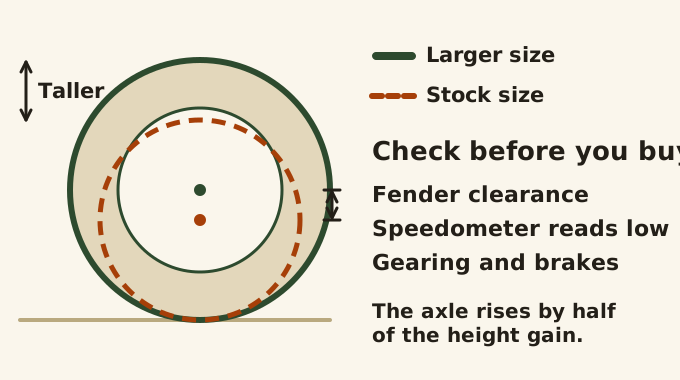
Moving from 245/75R16 to 265/75R16 keeps the 75 aspect ratio and the 16 in rim, so the tire grows only because it is wider: 20 mm of extra width adds 15 mm to each sidewall. That is about 1.2 in of extra diameter, around 4 percent, and the speedometer reads that much low.
+3.9% diameter change, 245/75R16 to 265/75R16
| Measure | A | B | Change |
|---|---|---|---|
| Overall diameter | 30.5 in | 31.6 in | +1.2 in (+3.9%) |
| Section width | 9.6 in | 10.4 in | +0.8 in |
| Sidewall height | 7.2 in | 7.8 in | +0.6 in |
| Circumference | 95.7 in | 99.4 in | +3.7 in |
| Revolutions per mile | 662 | 637 | -25 |
| Ground clearance at the axle | +0.59 in |
| At | Actual speed | Difference |
|---|---|---|
| Speedometer reads 30 mph | 31.2 mph actual | +1.2 mph |
| Speedometer reads 60 mph | 62.3 mph actual | +2.3 mph |
Speedometer rows assume the speedometer was calibrated for size A. Ground clearance rises by half the diameter change at the axle only; the lowest point (often the differential) does not move.
Nominal sizes from the formulas. Real tires differ by maker and tread; the maker's spec sheet lists the actual diameter.
How to use this tool
- Enter both sizes
Put the size you run now in A and the new size in B. Metric and flotation sizes can be mixed. - Check the change column
Diameter change drives speedometer error and gearing. Width change decides how much room the tire needs in the wheel well. - Read the speedometer rows
They show what the car is really doing when the speedometer reads 30 or 60 mph on size B, assuming it was set for size A.
Off-road gear on Amazon
SponsoredAs an Amazon Associate, Off Road Freedom earns from qualifying purchases. See our affiliate disclosure.
ETENWOLF Pencil Tire Pressure Gauge 2 Pack (10-50PSI, 20-120PSI) | Calibrated to ANSI B40.1 Grade B (2%), 16 Tire Caps, Stainless Steel Body, Stocking Stuffers for Men Women, Car Accessories
$7.99$5.99
View on Amazon (ETENWOLF Pencil Tire Pressure Gauge 2 Pack (10-50PSI, 20-120PSI) | Calibrated to ANSI B40.1 Grade B (2%), 16 Tire Caps, Stainless Steel Body, Stocking Stuffers for Men Women, Car Accessories)KSP 6X5.5 Wheel Spacers for Silverado Sierra,1.5 inch(38mm) Real Forged Spacers with 78.1mm Hub Bore M14x1.5 Studs fit for Tahoe Avalanche Express Suburban Sierra Yukon
$149.99
View on Amazon (KSP 6X5.5 Wheel Spacers for Silverado Sierra,1.5 inch(38mm) Real Forged Spacers with 78.1mm Hub Bore M14x1.5 Studs fit for Tahoe Avalanche Express Suburban Sierra Yukon)AstroAI Digital Tire Pressure Gauge 150PSI, ±1PSI Accuracy for Car Truck | Industrial Tire Gauge Calibrated to ANSI B40.7 with 4 Settings for Motorcycle Bikes, Silver
$12.99$6.99
View on Amazon (AstroAI Digital Tire Pressure Gauge 150PSI, ±1PSI Accuracy for Car Truck | Industrial Tire Gauge Calibrated to ANSI B40.7 with 4 Settings for Motorcycle Bikes, Silver)Dynofit 2 inch 5x4.5 Wheel Spacers for XJ KJ KK TJ ZJ, 80.5mm Hub Bore, 1/2"-20 Thread Pitch 5x114.3 Forged Spacer for Mustang Explorer Ranger Cherokee Wrangler Liberty Grand Cherokee
$97.99
View on Amazon (Dynofit 2 inch 5x4.5 Wheel Spacers for XJ KJ KK TJ ZJ, 80.5mm Hub Bore, 1/2"-20 Thread Pitch 5x114.3 Forged Spacer for Mustang Explorer Ranger Cherokee Wrangler Liberty Grand Cherokee)Zelythil Heavy Duty 4 Way Lug Wrench, Professional 14 Inch Cross Tire Iron Wrench, Universal Cross Wheel Lug Nut Removal Tool, Forged Heat-Treated Carbon Steel for Tire Changing and Auto Maintenance
$13.29
View on Amazon (Zelythil Heavy Duty 4 Way Lug Wrench, Professional 14 Inch Cross Tire Iron Wrench, Universal Cross Wheel Lug Nut Removal Tool, Forged Heat-Treated Carbon Steel for Tire Changing and Auto Maintenance)CARTMAN 14 Inch Heavy Duty 4 Way Universal Cross Lug Wrench Tire Iron | Built with sturdy thick steel structure, 4 integrated sockets sized 17/19mm & 21/22mm for effortless vehicle tire maintenance
$17.69
View on Amazon (CARTMAN 14 Inch Heavy Duty 4 Way Universal Cross Lug Wrench Tire Iron | Built with sturdy thick steel structure, 4 integrated sockets sized 17/19mm & 21/22mm for effortless vehicle tire maintenance)Maxracing 2" Leveling Kit Compatible with 2007-2026 Silverado Sierra 1500 | Compatible with 2007-2026 Silverado Sierra 1500, 2007-2020 Tahoe Yukon Suburban 1500, 2007-2013 Avalanche 1500 4WD/2WD
$34.88
View on Amazon (Maxracing 2" Leveling Kit Compatible with 2007-2026 Silverado Sierra 1500 | Compatible with 2007-2026 Silverado Sierra 1500, 2007-2020 Tahoe Yukon Suburban 1500, 2007-2013 Avalanche 1500 4WD/2WD)pgroup Telescoping Lug Wrench, Extended Lug Wheel Wrench with 17mm/19mm(3/4”), 21mm(13/16”)/22mm(7/8”) Chrome Vanadium Steel Sockets for Car, Truck, Vans
$18.99
View on Amazon (pgroup Telescoping Lug Wrench, Extended Lug Wheel Wrench with 17mm/19mm(3/4”), 21mm(13/16”)/22mm(7/8”) Chrome Vanadium Steel Sockets for Car, Truck, Vans)




Prices and availability were accurate when retrieved from Amazon and may change. Retrieved Nov 12, 2026.
How it is calculated
- Sidewall (mm) = width x aspect / 100. Diameter (in) = rim + 2 x sidewall / 25.4. Section width (in) = width / 25.4.
- Diameter = first number. Width = second number. Sidewall (in) = (diameter - rim) / 2.
- Actual speed = indicated speed x new diameter / old diameter.
- Ground clearance change at the axle = (new diameter - old diameter) / 2.
Results are nominal. Real tires differ by maker and tread, and the maker's spec sheet lists the actual diameter.
Frequently asked questions
How is tire size comparison calculated?
Each size is converted to overall diameter, width and sidewall using the size code, then the two are subtracted. The diameter change is shown in inches and as a percent of the original.
Does a bigger tire raise my whole vehicle?
The axle rises by half the diameter change, so a tire 2 in taller lifts the axle about 1 in. Your lowest point is usually the differential or a skid plate, which does not move, so clearance under those parts stays the same.
Why is the speedometer error shown at 30 and 60 mph?
The error is a fixed percentage, so it grows with speed. The two rows show how big the gap is around town and at road speed.
What does a 3 percent diameter change mean?
It is the guideline one tire maker gives for staying close to the original diameter. Past that, expect more noticeable speedometer and odometer error.
Will a wider tire with the same diameter fit?
Not necessarily. A tire of equal diameter can still be wider, which needs more room at full steering lock and on suspension travel. Width and wheel offset both matter, so check offset too.
Can I compare a metric size to a flotation size?
Yes. Both are converted to inches first, so 285/70R17 and 33x12.50R17 can be compared directly.
Link to this tool
Your numbers are saved in the link, so anyone who opens it sees the same result.
Sources
Last checked 2026-11-12. Each link was opened and read on that date.
- BFGoodrich: Changing tire size on a car: A different overall diameter changes speedometer and odometer accuracy.
- BFGoodrich: How to read a tire sidewall: Size code: width in millimeters, aspect ratio, R for radial, rim diameter, P and LT prefixes.
This guide reflects independent editorial research, not first-hand product testing, professional mechanical training, or rescue certification. Some links on this page are Amazon Associates affiliate links; see our affiliate disclosure.