

Off-road gear on Amazon
SponsoredAs an Amazon Associate, Off Road Freedom earns from qualifying purchases. See our affiliate disclosure.
Attwood PowardGuard Vented Marine Battery Box for Group 24 Batteries, Black | Fits Group 24, 24M and 24F batteries, vented, 10-5/8" x 7" x 10-1/8" interior, includes 40 inch strap, 9065-1
$10.99
View on Amazon (Attwood PowardGuard Vented Marine Battery Box for Group 24 Batteries, Black | Fits Group 24, 24M and 24F batteries, vented, 10-5/8" x 7" x 10-1/8" interior, includes 40 inch strap, 9065-1)BLUETTI Charger 1, 560W Alternator Charger, Fast DC-DC Charging | For Portable Power Stations, 6X Faster Than Car Cigarette Lighter, Compatible with 95% Solar Generator, Road Trips, RV Life
$399.00$218.98
View on Amazon (BLUETTI Charger 1, 560W Alternator Charger, Fast DC-DC Charging | For Portable Power Stations, 6X Faster Than Car Cigarette Lighter, Compatible with 95% Solar Generator, Road Trips, RV Life)NOCO Snap-Top BG31 Group 24-31 Battery Box | Marine and RV battery box for Group 24, 27 and 31 batteries, so you can size up a boat, camper or trailer battery later
$12.88
View on Amazon (NOCO Snap-Top BG31 Group 24-31 Battery Box | Marine and RV battery box for Group 24, 27 and 31 batteries, so you can size up a boat, camper or trailer battery later)Renogy 40A DC-DC Battery Charger 12V Multi-Stage for Lithium/AGM/Gel | 94% efficiency,alternator powered, Smart 3-stage,Li activation, over/short/thermal protection, smart alternator ready for RVs
$179.99
View on Amazon (Renogy 40A DC-DC Battery Charger 12V Multi-Stage for Lithium/AGM/Gel | 94% efficiency,alternator powered, Smart 3-stage,Li activation, over/short/thermal protection, smart alternator ready for RVs)A ABIGAIL 2 AWG Battery Cable 2AWG Gauge Pure Copper Battery Inverter Cables with 3/8 in Lugs Both Ends Power Inverter Wire Set for Automotive Solar Marine Boat RV Car Motorcycle Red and Black (1FT)
$15.99
View on Amazon (A ABIGAIL 2 AWG Battery Cable 2AWG Gauge Pure Copper Battery Inverter Cables with 3/8 in Lugs Both Ends Power Inverter Wire Set for Automotive Solar Marine Boat RV Car Motorcycle Red and Black (1FT))1/0 Gauge Wire 1/0 AWG Battery Cable (20FT Red+20FT Black), Copper Clad Aluminum CCA Amp Wiring Kit, Automotive Wire with Terminals Connectors, for Car Audio Speaker, Marine, RV Trailer
$59.89
View on Amazon (1/0 Gauge Wire 1/0 AWG Battery Cable (20FT Red+20FT Black), Copper Clad Aluminum CCA Amp Wiring Kit, Automotive Wire with Terminals Connectors, for Car Audio Speaker, Marine, RV Trailer)Stinger SGP32 High-Current 200A Car Audio Dual Battery Isolator & Relay | Universal compatibility, 100k mechanical cycle life, water-resistant design for marine or powersports stereos & accessories
$64.79
View on Amazon (Stinger SGP32 High-Current 200A Car Audio Dual Battery Isolator & Relay | Universal compatibility, 100k mechanical cycle life, water-resistant design for marine or powersports stereos & accessories)Schumacher Electric SDC371 Smart Battery Charger and Maintainer - 40A 12V DC-DC Smart Charger - Standard, AGM, Gel, Calcium & Lithium Battery Charger - Use with Solar Panels or Vehicle Alternator
$59.95
View on Amazon (Schumacher Electric SDC371 Smart Battery Charger and Maintainer - 40A 12V DC-DC Smart Charger - Standard, AGM, Gel, Calcium & Lithium Battery Charger - Use with Solar Panels or Vehicle Alternator)40FT 1/0 Battery Cable CCA,0 Gauge Wire with lugs for Amp,Winch,Automotive | 0 Gauge Wire Cable Copper Clad Aluminum,With 20pcs Terminal Connectors,for battery relocation kit,Reducer,Starter,Solar.
$59.99
View on Amazon (40FT 1/0 Battery Cable CCA,0 Gauge Wire with lugs for Amp,Winch,Automotive | 0 Gauge Wire Cable Copper Clad Aluminum,With 20pcs Terminal Connectors,for battery relocation kit,Reducer,Starter,Solar.)


Prices and availability were accurate when retrieved from Amazon and may change. Retrieved Nov 12, 2026.
What a dual battery setup does
A dual battery setup puts a second battery in the vehicle for the things you run when the engine is off: a fridge, camp lights, a laptop, a radio. The starting battery stays reserved for starting. A charger or isolator links the two while the engine runs, so the second battery recharges as you drive.
That separation is the point. If you drain the auxiliary battery at camp, you still have a full starting battery in the morning.
Isolator vs DC-DC charger
The link between the batteries is the main choice. REDARC's guidance on choosing a charger is the source for this table.
| Feature | Isolator | DC-DC charger |
|---|---|---|
| Suits | Older vehicles (REDARC says generally before 2015) with a fixed-voltage alternator | Newer vehicles (REDARC says after 2015) with variable-voltage alternators |
| How it works | Joins the batteries and relies on the alternator's output, which may be the wrong voltage for the second battery | Regulates the charge going into the second battery and can detect the battery type |
| Long cable runs | Not built to overcome voltage drop on long cable runs | Better able to overcome voltage drops over longer distances |
| Solar | No | Needed if you want to charge from solar as well (REDARC) |
| Cost | REDARC calls it cost-effective | Check current prices for the model you need |
Check your vehicle: your owner's manual or dealer can tell you what kind of alternator you have. If it is variable-voltage, plan on a DC-DC charger.
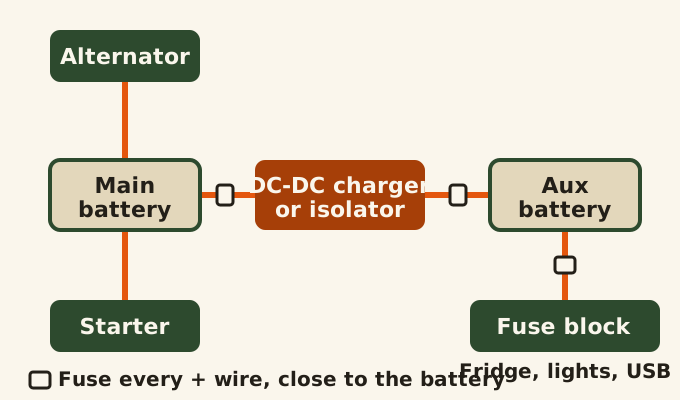
How it is laid out
The diagram above shows the usual layout. Power flows from the alternator to the starting battery, through the isolator or DC-DC charger to the second battery, and from the second battery through a fuse block to your loads.
| Part | What it does | Notes |
|---|---|---|
| Starting battery | Starts the engine | Stays reserved for starting |
| Auxiliary battery | Runs the fridge, lights and gear | Use the type your charger maker supports |
| Isolator or DC-DC charger | Links the batteries while the engine runs | See the table above |
| Fuses | Protect each cable run | Close to the battery, sized from the maker's diagram |
| Cable and terminals | Carry the current | Size from the kit or charger maker's chart |
| Battery box or tray | Holds the battery in place | Secure; follow the battery maker's guidance on venting |
| Fuse block | Feeds fridge, lights, USB | Fuse each load |
Size it from your loads
List what you will run and for how long. Energy in watt-hours is power in watts times hours. A load that draws 40 W for 10 hours uses 400 Wh. Add up your loads, then compare with the battery's rated capacity and the usable fraction its maker states. Treat every runtime you work out this way as an estimate.
For a worked comparison of capacity and loads, see comparing portable power stations, which uses the same arithmetic.
Installation outline
Follow your charger and kit maker's instructions; they decide cable sizes, fuse values and terminals. In outline:
- Plan the layout.
Choose where the second battery, charger and fuse block sit, keeping cable runs short and clear of heat and moving parts. - Disconnect the negative terminal.
Take the starting battery's negative lead off before any other work. - Mount the second battery and charger.
Secure the battery in a box or tray. Mount the charger where its maker says. - Run the cables.
Use the cable size from the maker's chart, with grommets where cables pass through metal. - Fuse each positive run.
Place a fuse close to each battery on the positive cable, with the value from the maker's diagram. - Connect grounds and reconnect.
Connect to clean bare metal or the battery negative as the maker says, then reconnect the starting battery. - Test and label.
Check charging with the engine running, then label the fuses so you know what each protects.
Common mistakes
- Choosing an isolator for a vehicle whose alternator varies its voltage, without checking the charger maker's guidance.
- Fitting a battery type the charger does not support.
- Leaving out fuses, or placing a fuse far from the battery.
- Using cable that is too thin for the run, which causes voltage drop and heat.
- Mounting the battery loose, or somewhere it can vent into the cabin.
- Not labelling circuits, so you cannot work out later what a fuse protects.
Checks after installing
- Start the engine and check that the second battery is charging at the charger's display or with a voltmeter.
- Switch off the engine and confirm loads run from the second battery only.
- Check every terminal and cable after the first trip for loose fittings and chafing.
- Recheck the layout against the maker's instructions once the rig has been shaken on a trail.
Gear for this
Affiliate links-




Current Amazon results
Led light bar
Check voltage, wiring needs and local rules on aux lighting before you buy.
See options on Amazon -


Current Amazon results
Ditch lights
Check voltage, wiring needs and local rules on aux lighting before you buy.
See options on Amazon -


Current Amazon results
Rock lights
Check voltage, wiring needs and local rules on aux lighting before you buy.
See options on Amazon -


Current Amazon results
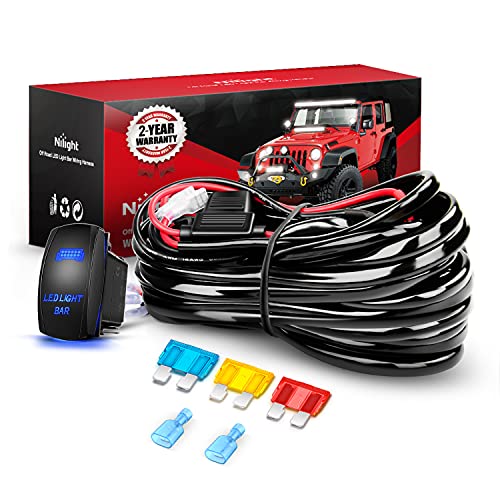
Light bar wiring harness
Check voltage, wiring needs and local rules on aux lighting before you buy.
See options on Amazon