
Winch Size Calculator: What Rating Do You Need?
Worked example
WARN's own example is a 2016 Toyota Tacoma with a GVWR of 5,600 lb. Multiplied by 1.5 that is 8,400 lb, so WARN says an 8,000 lb winch would suffice and a 9,000 or 10,000 lb one would be a step up. The tool shows the same arithmetic, then marks each common rating as meeting the minimum or not.
8,400 lb minimum pulling capacity: 5,600 lb x 1.50
| Step | Result |
|---|---|
| Gross vehicle weight rating (GVWR) | 5,600 lb |
| Multiplier | 1.50 |
| Minimum pulling capacity | 8,400 lb |
| Smallest rating in the list at or above it | 9,000 lb |
| Winch rating | Meets the minimum? |
|---|---|
| 8,000 lb | No |
| 9,000 lb | Yes |
| 10,000 lb | Yes |
| 12,000 lb | Yes |
| 15,000 lb | Yes |
| 16,500 lb | Yes |
The 1.5 multiplier is the one WARN and Superwinch each state on their own pages. Pulling up an incline or out of mud needs more, Superwinch says, so this is a floor, not a promise. Use GVWR from the door sticker, not curb weight.
How to use this tool
- Find your GVWR
Read the gross vehicle weight rating on the sticker in the driver's door frame or in the owner's manual. Use GVWR, not curb weight. - Add a trailer if you tow one
Superwinch says to use the gross combined weight rating when you tow a trailer off-road. Enter the trailer weight and the tool adds it. - Read the table
The headline is the minimum capacity. The table marks which winch ratings meet it. Treat it as a floor and read the winch maker's guidance before you buy.
How it is calculated
- Minimum pulling capacity = GVWR x 1.5 (WARN and Superwinch). With a trailer, use the gross combined weight rating x 1.5 (Superwinch).
These are estimates from the formulas and the assumptions shown. They are not a promise of performance.
Frequently asked questions
How do I work out what size winch I need?
Multiply your vehicle's gross vehicle weight rating by 1.5. WARN calls the result your minimum pulling capacity, and Superwinch gives the same 1.5 multiplier. Then choose a winch rated at or above it.
Where do I find my GVWR?
On the sticker in the driver's door frame, or in the owner's manual. WARN says to use GVWR, the vehicle's maximum operating weight, and not curb weight, which excludes people and cargo.
Should I buy the biggest winch I can?
Not necessarily. Superwinch gives reasons beyond cost, including the vehicle weight and the angle and type of pull. A winch with some spare capacity helps, but match it to your vehicle and the winch maker's guidance.
What if I tow a trailer?
Superwinch says to base the calculation on the gross combined weight rating, which is the vehicle's GVW plus the trailer weight. The tool has a trailer field for that.
Why does a steep or muddy pull need more?
Superwinch notes that pulling up an incline takes more power than a flat pull, and so does pulling out of a mud pit. That is why the 1.5 figure is a minimum and not a safe-for-everything number.
Does line pull change on the drum?
Winch makers often publish how pull changes by layer, but we did not read a maker page for it, so the tool does not model it. Check the winch maker's chart for the pull at each layer.
How much can a 12000 lb winch pull?
The rating is the most the maker designs the winch to pull under its stated conditions. Real pulls depend on the vehicle's weight, the slope, mud and rigging. With the 1.5 multiplier used here, a 12,000 lb winch covers a vehicle with a GVWR up to 8,000 lb. Read the winch maker's own rating notes.
How big of a winch do I need for a 3-4 ton truck?
Enter its GVWR. If 3 to 4 tons means 6,000 to 8,000 lb of GVWR, the 1.5 multiplier gives 9,000 to 12,000 lb as a minimum. Add a margin for steep or muddy pulls and use the combined weight when towing a trailer. Check the figure on your door-jamb label.
Link to this tool
Your numbers are saved in the link, so anyone who opens it sees the same result.
Sources
Last checked 2026-11-12. Each link was opened and read on that date.
- WARN: determine the right winch capacity for your truck or SUV: GVWR x 1.5 = minimum pulling capacity; use GVWR, not curb weight; Tacoma 5,600 lb example.
- Superwinch: what size winch do I need: Vehicle GVW x 1.5; use GCWR when towing a trailer; incline and mud need more.
This guide reflects independent editorial research, not first-hand product testing, professional mechanical training, or rescue certification. Some links on this page are Amazon Associates affiliate links; see our affiliate disclosure.
Off-road gear on Amazon
SponsoredAs an Amazon Associate, Off Road Freedom earns from qualifying purchases. See our affiliate disclosure.
VEVOR Electric Winch, 12000 lbs Load Capacity, 12V DC Truck Winch with Φ3/8 in x 92 ft Synthetic Rope, Wireless & Wired Remote Control, IP68 Waterproof for Towing Off-Road SUV Jeep Trailer Boat
$339.90
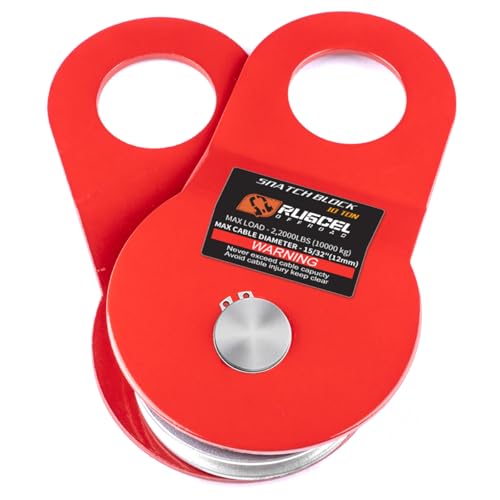
View on Amazon (VEVOR Electric Winch, 12000 lbs Load Capacity, 12V DC Truck Winch with Φ3/8 in x 92 ft Synthetic Rope, Wireless & Wired Remote Control, IP68 Waterproof for Towing Off-Road SUV Jeep Trailer Boat)RUGCEL WINCH 10T Snatch Block Pulley 22000lb, Winch Pulley Blocks Snatch Rigging Blocks, Heavy Duty Offroad Recovery Towing Accessory for Truck Tractor
$23.50$19.99
View on Amazon (RUGCEL WINCH 10T Snatch Block Pulley 22000lb, Winch Pulley Blocks Snatch Rigging Blocks, Heavy Duty Offroad Recovery Towing Accessory for Truck Tractor)OPENROAD 13500 lb Recovery Winch with Synthetic Rope and 2 Wireless Remotes - IP68 Waterproof 12V Electric Winch for Jeep, SUV, Truck & Trailer - Panther Series 3S
$359.99$305.99
View on Amazon (OPENROAD 13500 lb Recovery Winch with Synthetic Rope and 2 Wireless Remotes - IP68 Waterproof 12V Electric Winch for Jeep, SUV, Truck & Trailer - Panther Series 3S)AXSIPEIX Synthetic Winch Rope Kit, 1/4" x 50ft 10000LBS Blue Winch Cable with Protective Sleeve, Forged Winch Hook, Rubber Stopper and Safety Pull Strap for ATV UTV
$29.74$23.96
View on Amazon (AXSIPEIX Synthetic Winch Rope Kit, 1/4" x 50ft 10000LBS Blue Winch Cable with Protective Sleeve, Forged Winch Hook, Rubber Stopper and Safety Pull Strap for ATV UTV)SINOKING 13500 lb Electric Winch for Jeep, Truck, SUV, Trailer Winch & Boat Winch – Heavy Duty Synthetic Rope 12V Winch, Waterproof Towing Winch with Wireless and Wired Remote
$299.00$269.99
View on Amazon (SINOKING 13500 lb Electric Winch for Jeep, Truck, SUV, Trailer Winch & Boat Winch – Heavy Duty Synthetic Rope 12V Winch, Waterproof Towing Winch with Wireless and Wired Remote)TYT 3000 lb ATV Winch with Wireless Remote and Wired Switch,12V DC Electric Winch Synthetic Winch Rope with Fairlead and Winch Mounting Plate
$89.99$76.49
View on Amazon (TYT 3000 lb ATV Winch with Wireless Remote and Wired Switch,12V DC Electric Winch Synthetic Winch Rope with Fairlead and Winch Mounting Plate)USYATO 2 Ton (4,400Lbs) Snatch Block with 2FT G80 Chain & Grab Hook,Detachable Buckle,3" Sheave 3/8" Wire Rope Winch Pulley,Heavy Duty Snatch Block Pulley for Towing,Logging,Car,SUV,Small Truck,1 Pair
$59.99
View on Amazon (USYATO 2 Ton (4,400Lbs) Snatch Block with 2FT G80 Chain & Grab Hook,Detachable Buckle,3" Sheave 3/8" Wire Rope Winch Pulley,Heavy Duty Snatch Block Pulley for Towing,Logging,Car,SUV,Small Truck,1 Pair)AC-DK 2500 lb ATV/UTV Winch Kit, 12V Electric Winch with Synthetic Rope, Wireless & Wired Remote, Mounting Plate for Off-Road Trailer, Boat, RV Towing
$90.99$76.49
View on Amazon (AC-DK 2500 lb ATV/UTV Winch Kit, 12V Electric Winch with Synthetic Rope, Wireless & Wired Remote, Mounting Plate for Off-Road Trailer, Boat, RV Towing)




Prices and availability were accurate when retrieved from Amazon and may change. Retrieved Nov 27, 2026.