
Tire Pressure Calculator: Temperature and Air-Down
Worked example
A tire set to 32 psi at 75 °F is moved to a 35 °F morning. The gas law estimates about 28.5 psi, roughly 3.5 psi lower, which is why pressure is set cold and rechecked as the weather changes. For the air-down side: 25 percent below a 32 psi placard is 24 psi. That is arithmetic, not advice on what is right for your tires and trail.
28.5 psi estimated gauge pressure at 35 °F
| When | Temperature | Pressure |
|---|---|---|
| Now | 75 °F | 32.0 psi |
| Then | 35 °F | 28.5 psi |
| Change | -40 °F | -3.5 psi |
An estimate from the gas law at sea level, for a sealed tire with no leak. Set your pressure cold, from the placard.
How to use this tool
- Start from the placard
Find the pressure on the label in the driver's door jamb or in the owner's manual. Never start from a number you read somewhere else. - Use the temperature panel
Enter the pressure you set, the temperature then and the temperature you expect, and read the estimated change. - Use the air-down panel
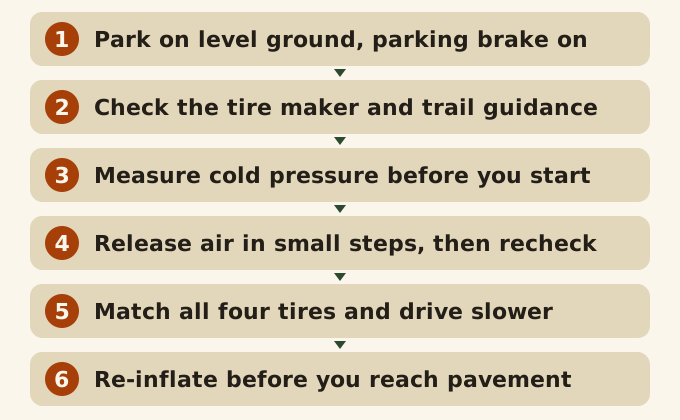
Enter the placard pressure and either a percentage or a target. Check the result against your tire maker's guidance before you let air out.
Off-road gear on Amazon
SponsoredAs an Amazon Associate, Off Road Freedom earns from qualifying purchases. See our affiliate disclosure.
ETENWOLF Pencil Tire Pressure Gauge 2 Pack (10-50PSI, 20-120PSI) | Calibrated to ANSI B40.1 Grade B (2%), 16 Tire Caps, Stainless Steel Body, Stocking Stuffers for Men Women, Car Accessories
$7.99$5.99
View on Amazon (ETENWOLF Pencil Tire Pressure Gauge 2 Pack (10-50PSI, 20-120PSI) | Calibrated to ANSI B40.1 Grade B (2%), 16 Tire Caps, Stainless Steel Body, Stocking Stuffers for Men Women, Car Accessories)Airmoto Tire Inflator Portable Air Compressor for Cars, Bikes and Bicycles | Cordless Air Pump with Digital Pressure Gauge, Bright LED & Auto Shut-Off, Works on All Tires and Inflatables
$89.00$69.99
View on Amazon (Airmoto Tire Inflator Portable Air Compressor for Cars, Bikes and Bicycles | Cordless Air Pump with Digital Pressure Gauge, Bright LED & Auto Shut-Off, Works on All Tires and Inflatables)AstroAI Digital Tire Pressure Gauge 150PSI, ±1PSI Accuracy for Car Truck | Industrial Tire Gauge Calibrated to ANSI B40.7 with 4 Settings for Motorcycle Bikes, Silver
$12.99$6.99
View on Amazon (AstroAI Digital Tire Pressure Gauge 150PSI, ±1PSI Accuracy for Car Truck | Industrial Tire Gauge Calibrated to ANSI B40.7 with 4 Settings for Motorcycle Bikes, Silver)AIRSURE Tire Inflator Portable Air Compressor, 150PSI Fast Inflation | Cordless Air Pump for Car Tires, Bikes, Motorcycles, Auto Shut-off, Digital Gauge & LED Light, Rechargeable Battery
$19.99
View on Amazon (AIRSURE Tire Inflator Portable Air Compressor, 150PSI Fast Inflation | Cordless Air Pump for Car Tires, Bikes, Motorcycles, Auto Shut-off, Digital Gauge & LED Light, Rechargeable Battery)OlarHike Tire Inflator Portable Air Compressor,Dual Power-3*2000mAh &12V DC | Lightning-Fast Inflation, Auto Shut-off, Cordless Air Pump for Car Tires, Bikes, Balls with LED & Digital Pressure Gauge
$34.99$29.99
View on Amazon (OlarHike Tire Inflator Portable Air Compressor,Dual Power-3*2000mAh &12V DC | Lightning-Fast Inflation, Auto Shut-off, Cordless Air Pump for Car Tires, Bikes, Balls with LED & Digital Pressure Gauge)JACO Auto-Stop Air Down Tire Deflators (Adjustable 10-30 PSI) for Off Road | 4X4 Off Road Screw-on Deflation Valves; Automatic Stop at Preset PSI; with Storage Pouch & Valve Caps
$39.90
View on Amazon (JACO Auto-Stop Air Down Tire Deflators (Adjustable 10-30 PSI) for Off Road | 4X4 Off Road Screw-on Deflation Valves; Automatic Stop at Preset PSI; with Storage Pouch & Valve Caps)DORNATA Adjustable Tire Deflator Auto-Stop (10-40 PSI) Offroad Accessories | Valve Stem kit 4x4 Tyre Air Down Tool for Truck, Pickup, Motorcycle,Jeep etc.(BLACK)
$33.42$31.74
View on Amazon (DORNATA Adjustable Tire Deflator Auto-Stop (10-40 PSI) Offroad Accessories | Valve Stem kit 4x4 Tyre Air Down Tool for Truck, Pickup, Motorcycle,Jeep etc.(BLACK))Rhino USA Adjustable Tire Deflator Kit (4-Pack) - 10-30 PSI Air Down Tool | Automatic Screw-On Deflators with Auto Stop. Offroad Accessory for Jeep, Truck, SUV, ATV & 4x4 Sand Trails. Black
$39.90
View on Amazon (Rhino USA Adjustable Tire Deflator Kit (4-Pack) - 10-30 PSI Air Down Tool | Automatic Screw-On Deflators with Auto Stop. Offroad Accessory for Jeep, Truck, SUV, ATV & 4x4 Sand Trails. Black)





Prices and availability were accurate when retrieved from Amazon and may change. Retrieved Nov 12, 2026.
How it is calculated
- P2 = (P1 + 14.7) x (T2 / T1) - 14.7, gauge psi, sea level, temperatures in kelvin. An estimate.
Results are nominal. Real tires differ by maker and tread, and the maker's spec sheet lists the actual diameter.
Frequently asked questions
Where do I find the right tire pressure for my vehicle?
On the placard in the driver's door jamb or in the owner's manual. One tire industry group also says to check pressure when the tires are cold, meaning the vehicle has been parked for at least three hours.
How does temperature change tire pressure?
Gas pressure follows absolute temperature, so a colder tire has lower pressure and a warmer one has higher. The tool uses the gas law at sea level and labels the result an estimate.
Is there a safe air-down pressure for trails?
We do not publish one. Safe pressure depends on the tire, load, wheel and terrain. If you want a range, use one published by your tire maker and cite it for yourself.
What does the air-down percentage mean?
It is the share of your placard pressure you take out. At 20 percent on a 35 psi placard you end up at 28 psi. The tool only does that subtraction.
Why re-inflate before driving at road speed?
A tire at low pressure flexes more and heats more at speed, and handling changes. Treat air-down as an off-pavement, low-speed measure and re-inflate before you leave the trail.
Do LT and P-metric tires behave the same when aired down?
No. They are built and rated differently, so the placard and the tire maker's information for your type of tire come first. Read the sidewall to see which you have.
Why does the tool ask for the placard pressure?
Because every air-down starts from the pressure the vehicle maker specifies. Typing your own number keeps the result tied to your vehicle, not to a generic table.
Link to this tool
Your numbers are saved in the link, so anyone who opens it sees the same result.
Sources
Last checked 2026-11-12. Each link was opened and read on that date.
- USTMA: Tire care essentials: Recommended pressure is on the driver's door label or in the owner's manual; check when tires are cold.
This guide reflects independent editorial research, not first-hand product testing, professional mechanical training, or rescue certification. Some links on this page are Amazon Associates affiliate links; see our affiliate disclosure.