Spot vs Flood Beam Patterns: The Basics
When people compare spot vs flood beam patterns, they are really comparing how light is shaped for the trail. A spot beam concentrates light into a narrow path for distance, while a flood beam spreads light wider for coverage. That difference affects how far you can see, how much of the trail you can read at once, and how well the light fits your driving style.
For off-road lighting, neither pattern is automatically better. The right choice depends on speed, terrain, and what you want to see first. A narrow beam can help you spot obstacles farther ahead. A wider beam can help with corners, camp tasks, and close-in trail detail. Many drivers end up using a mix because one pattern rarely solves every lighting need on its own.
It also helps to separate beam pattern from raw brightness. Two lights can both be bright, yet one may be far better for distance and the other for coverage. Looking only at output numbers can be misleading if the beam shape does not match the job.
How Spot Beams Behave on the Trail
Spot beams are designed to project light farther ahead by keeping the beam tight. That makes them useful when you want to read the trail at speed, scan distant ridges, or pick out obstacles before you reach them. On open dirt roads and wider desert tracks, a spot pattern can feel efficient because it puts illumination where your eyes need it most: down the centerline and into the distance.
In practical use, a spot beam can make ruts, washouts, rocks, and terrain changes easier to notice earlier. That extra warning can matter when the trail opens up and your reaction time becomes part of the equation. If you often drive in open areas with longer sightlines, spot beams can be a strong part of your lighting plan.
The tradeoff is coverage. A very narrow beam may leave the sides of the trail dim, which can make it harder to see brush, berms, or changes in the shoulder. In tight wooded routes or technical terrain, a spot-only setup can feel tunnel-like. That is why spot lights often work best when paired with other lighting that fills in the near and side areas.
How Flood Beams Behave on the Trail
Flood beams spread light across a broader area, which makes them useful when you want a wide view instead of maximum reach. This can be especially helpful on tight trails, in campsites, during gear loading, or anywhere you need to see the edges of the vehicle and the surrounding terrain. A flood pattern can make the scene feel more natural because the light is distributed across more of what is in front of you.
On off-road trails, flood lighting is often appreciated for low-speed crawling and technical sections. When you are moving carefully over rocks, roots, shelves, or uneven ground, a wide beam can show the immediate environment more clearly. It can help with tire placement, reading banks, and noticing obstacles that are close to the vehicle but not directly in front of it.
The downside is distance. Because the light is spread out, a flood beam usually does not reach as far as a spot beam. At higher speeds or on long straight stretches, you may feel like the trail disappears into darkness ahead even though the area near the vehicle is well lit. That is why flood beams are often better as a complement to distance lighting than as a replacement for it.
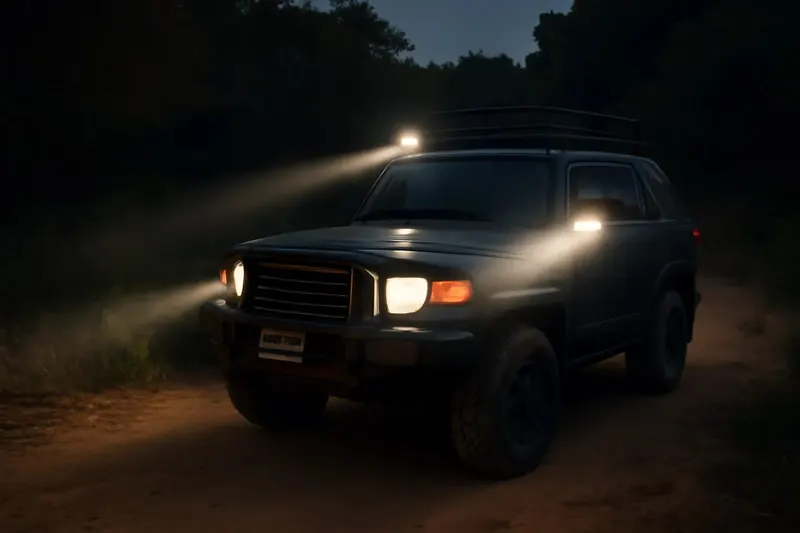
Choose by Trail Type, Speed, and Terrain
The best way to think about spot vs flood beam patterns is to start with your most common trail conditions. If you spend more time on open roads, desert tracks, or wide two-track routes, spot beams may deserve more attention because they help you see farther ahead. If your routes are tighter, slower, and more technical, flood beams may be more useful day to day because they light the near field and trail edges.
Speed matters too. The faster you go, the more useful distance lighting becomes because your eyes need more time to detect and process what is coming. At lower speeds, you are more likely to benefit from wide, even light that helps with precise line choice. That is one reason many off-road setups combine beam patterns rather than relying on a single style.
Terrain changes the equation as well. In dust, light can scatter and reduce visibility. In fog, rain, or snow, very wide beams may reflect back more than you want. In those conditions, careful beam selection and light placement matter just as much as brightness. The most useful setup is the one that helps you see the trail without overwhelming your own line of sight.
Browse our recommended gear
Our featured picks refresh periodically. While we update them, our editorial guides can help you find the right gear for your rig.
See our guidesWhy Many Drivers Mix Spot and Flood
In real off-road use, a mixed setup often makes more sense than choosing just one beam pattern. Spots can extend your view down the trail, while floods fill in the near and side areas. Together, they create a more complete lighting picture that feels easier to use across changing terrain.
A common approach is to place narrower beams where long-range visibility matters most and wider beams where side coverage is helpful. That does not mean every vehicle needs the same arrangement. Some drivers prefer a simple pair of lights with different patterns, while others may want a broader system that includes lights aimed at the sides or rear for camp and trail tasks.
Mixing patterns can also reduce eye fatigue. When the beam shape fits the terrain, you spend less effort mentally reconstructing what is outside the light cone. That can matter on long nights or when the route alternates between open stretches and tight turns. For many buyers, the practical question is not which pattern is best in theory, but which pattern best supports the way they actually drive.
Mounting and Aiming Matter as Much as Beam Pattern
Beam pattern is important, but placement and aim can change the way a light performs just as much. A well-chosen flood light mounted too high or aimed poorly may feel less useful than a modest light installed in the right location. The same is true for spots: a narrow beam needs to point where you actually need distance visibility, not just where it is easiest to mount.
Mounting height affects how the light reaches the trail. Higher mounting can help with forward visibility, but it can also increase glare off dust and make close obstacles harder to read. Lower mounting can improve the sense of width and reduce harsh reflection, though it may be more exposed to trail abuse. There is no perfect height for every vehicle, so the best choice depends on the vehicle design and the terrain you expect to drive.
Aim is equally important. A spot beam aimed too high can waste useful light and create glare. A flood beam aimed too low may only light the bumper area instead of the trail ahead. Small changes can make a big difference, so it is worth testing the setup in a controlled, low-risk environment before relying on it off-road.
Common Mistakes When Shopping for Off-Road Lights
One of the most common mistakes is choosing a light based on brightness alone. Lumens matter less than where the light lands. A very bright beam that is shaped poorly for your terrain can feel less effective than a moderate beam with the right spread and reach. For off-road use, beam pattern is often the more practical starting point.
Another mistake is buying only one pattern and expecting it to handle every situation. A spot may work well on open roads but feel limited in tight woods. A flood may feel great in camp but less helpful at speed. If your driving varies, a mixed setup or a more versatile plan is usually smarter.
Some buyers also overlook glare and stray light. Wide beams can brighten the area, but they can also create reflection from dust, rain, and nearby surfaces. Similarly, a narrow beam can be too concentrated if it is not aimed properly. Testing under real conditions is more useful than judging by catalog descriptions alone.
A Practical Way to Decide
If you are trying to decide between spot vs flood beam patterns, start with your most common use case. For distance, open terrain, and faster travel, spot beams deserve serious consideration. For close-range visibility, slower technical trails, and around-vehicle tasks, flood beams usually make more sense. If your driving includes both, a combination may be the most versatile path.
A useful buying mindset is to ask three questions: where do I need the light, how fast do I usually travel, and what kind of terrain do I see most often? Those answers usually point toward the beam pattern that will serve you best. That approach is more reliable than chasing the biggest output number or assuming one style is automatically superior.
For many off-road owners, the ideal setup evolves over time. A first purchase might favor floods for easier trail handling, while later additions may include spots for distance. That is normal. Lighting is one of those areas where experience teaches you what you actually use, not just what sounds impressive in a product listing.
In the end, the goal is simple: make the trail easier to read, not more complicated. Choose the beam pattern that supports clear, calm decision-making, then build from there.