Why Spotting Communication Matters
Spotting communication principles start with a simple idea: one person can often see hazards sooner, and the driver needs that information quickly and clearly. On a trail, the difference between a smooth line and a damaged vehicle is often a few well-timed words or a clean hand signal. Good communication also reduces hesitation, which helps a group move with less stress and fewer mistakes. For beginners, spotting can feel like a lot to absorb at once, especially when terrain changes every few feet. The best approach is to keep the system small, repeatable, and easy to remember under pressure.
Experienced groups often look casual on the surface, but they usually rely on a shared language that has been practiced enough to become routine. That routine matters because off-road conditions can quickly crowd your attention with noise, dust, and blind spots. Spotting is not only about showing a driver where to place a tire; it is also about keeping the whole group aligned on pace and intent. When everyone understands how the communication flow works, fewer people talk over each other and fewer decisions are left to guesswork. In that sense, spotting is part safety tool and part trail efficiency, and both benefits depend on clarity.
Agree on Signals Before Moving
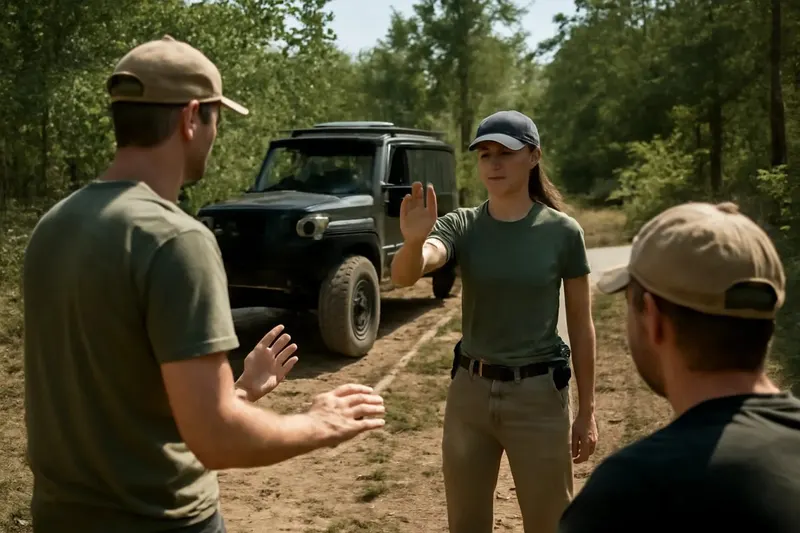
Before the wheels start turning, the group should agree on a small set of signals that everyone can recognize. Spotting communication principles work best when basic commands mean the same thing every time, such as stop, slow, driver, passenger, and straight. A short pre-roll discussion prevents confusion later, when engine noise, wind, and terrain make it harder to hear or think clearly. It also helps to assign roles before the vehicle enters a tight section. The driver should know who is spotting, where that person will stand, and what to do if the spotter is out of sight.
If multiple people are talking at once, the safest move is to pause and reset rather than guess which instruction is correct. This may feel overly cautious at first, but it usually saves time compared with correcting a poor setup after the vehicle has already committed to a line. A quick agreement also helps define what the spotter is and is not responsible for. For example, one person should lead the call while others stay quiet unless the driver asks for another viewpoint. That simple structure keeps the conversation organized and reduces the chance of conflicting directions when the vehicle is inches from an obstacle.
Keep Instructions Short and Consistent
Once the vehicle is moving, the best spotting calls are short, specific, and calm. Spotting communication principles favor brief directions because drivers have only a moment to process each instruction before the next terrain feature arrives. A spotter who says less but says it well is usually more helpful than one who narrates every inch of the trail. Clear words such as stop, a little driver, a little passenger, or straight ahead are easier to act on than long explanations spoken in a hurry.
Consistency matters just as much as brevity. If stop means stop, then it should never also mean slow down or hold position for a second longer. Mixed meanings create uncertainty, and uncertainty is a poor match for uneven ground, tight trees, or off-camber surfaces. When a group uses the same words in the same way across every obstacle, the driver can react faster and with more confidence. It also helps if the spotter avoids changing vocabulary from one section to the next, because even small differences can slow the driver’s response. A stable pattern gives everyone a better chance to stay focused on the terrain instead of decoding instructions.
Browse our recommended gear
Our featured picks refresh periodically. While we update them, our editorial guides can help you find the right gear for your rig.
See our guidesPosition Spotter and Driver for Visibility
Spotting communication principles depend on sightlines as much as they depend on words. A spotter should stand where the driver can see both the person and the intended line, while staying clear of tire paths and rollover hazards. If the angle changes, the spotter may need to move, but only in ways that preserve visibility and safety. The goal is not to stand in the same place every time, but to stand in a place that makes the next instruction easy to read. Good positioning also leaves room for the driver to correct the vehicle without feeling rushed or boxed in.
The driver should also be set up to see the spotter without cranking the wheel or stretching to look around obstacles. That means the spotter may need to stand slightly ahead, slightly off to one side, or in another location that matches the obstacle and the vehicle’s size. What matters is not a fixed spot, but a position that makes the next command easy to read. When visibility is poor, the group should slow down rather than forcing communication through a bad angle. It is also wise to keep bystanders out of the sightline, since extra movement near the obstacle can distract the driver and blur the spotter’s message. Clean positioning supports clean decisions.
Use Radio and Hand Signal Backups
Many groups use handheld radios, trail radios, or other communication devices to supplement direct spotting. These tools can be helpful when the spotter is out of the driver’s immediate view, when dust reduces visibility, or when the group needs to coordinate more than one vehicle. Even so, electronics should support the spotting process rather than replace basic visual communication. A radio can extend a simple message, but it should not become a substitute for the driver’s ability to read direction from the spotter’s body position and hands. That balance is especially useful when a trail bends, terrain blocks the line of sight, or the group needs to keep another vehicle paused until the obstacle is clear.
A backup hand signal is valuable because batteries, interference, and distance can all complicate a radio-only approach. Before moving, the group should decide which system is primary and which one is secondary. If the radio call and the hand signal disagree, the safest choice is to stop and clarify instead of assuming one will correct the other. That pause protects the group from acting on partial information. It also helps to keep the radio language just as concise as the hand signals, because long explanations can distract from the next immediate move. A second channel is most useful when it reinforces, rather than competes with, the first.
Review and Adapt After Each Obstacle
The strongest spotting communication principles continue after the vehicle clears an obstacle. A quick review helps the group notice what worked, what felt unclear, and whether any signal should be simplified before the next section. This does not need to become a formal debrief; even a few plain sentences can improve the next run. A short check-in also gives the driver a chance to mention blind spots, mirror issues, or moments when the call came too late to be useful. Those notes are practical because they let the group adapt to the specific vehicle and terrain instead of assuming one system will fit every situation.
When conditions change, the communication plan should change with them. A wide, open approach may allow relaxed spacing, while a narrow, rocky section may call for tighter coordination and fewer voices. The same is true when weather, dust, or fatigue starts affecting attention. Instead of pushing through with the same pattern, the group should adapt the system to match the terrain and the moment. That adaptation can be as simple as slowing the pace, moving the spotter to a clearer angle, or resetting the group before the next obstacle. Good teams treat communication as a living part of trail readiness, not a one-time setup.